Agentic AI in Contract Management: What It Actually Does

Every CLM vendor in 2026 has “AI agents.” That doesn’t help you evaluate any of them.

Because “agent” means radically different things across vendors. One platform calls a clause-suggestion popup an “agent.” Another calls a chatbot trained on your playbook an “agent.” A third — and this is the one worth paying attention to — has agentic AI in contract management that monitors 5,000 active contracts overnight, flags the three approaching auto-renewal, drafts the renewal terms, and routes them to the right owner before anyone’s first coffee.

Those three vendors are not competitors. They’re not even in the same category. But your procurement team is sitting in a comparison spreadsheet trying to score them on a single “AI agents” row.

This article cuts through that. In about ten minutes, you’ll know what agentic AI in contract management actually does, how it differs from “AI features” in legacy CLM, how much human oversight it requires, and what real customers see when they deploy it — with numbers, not predictions.

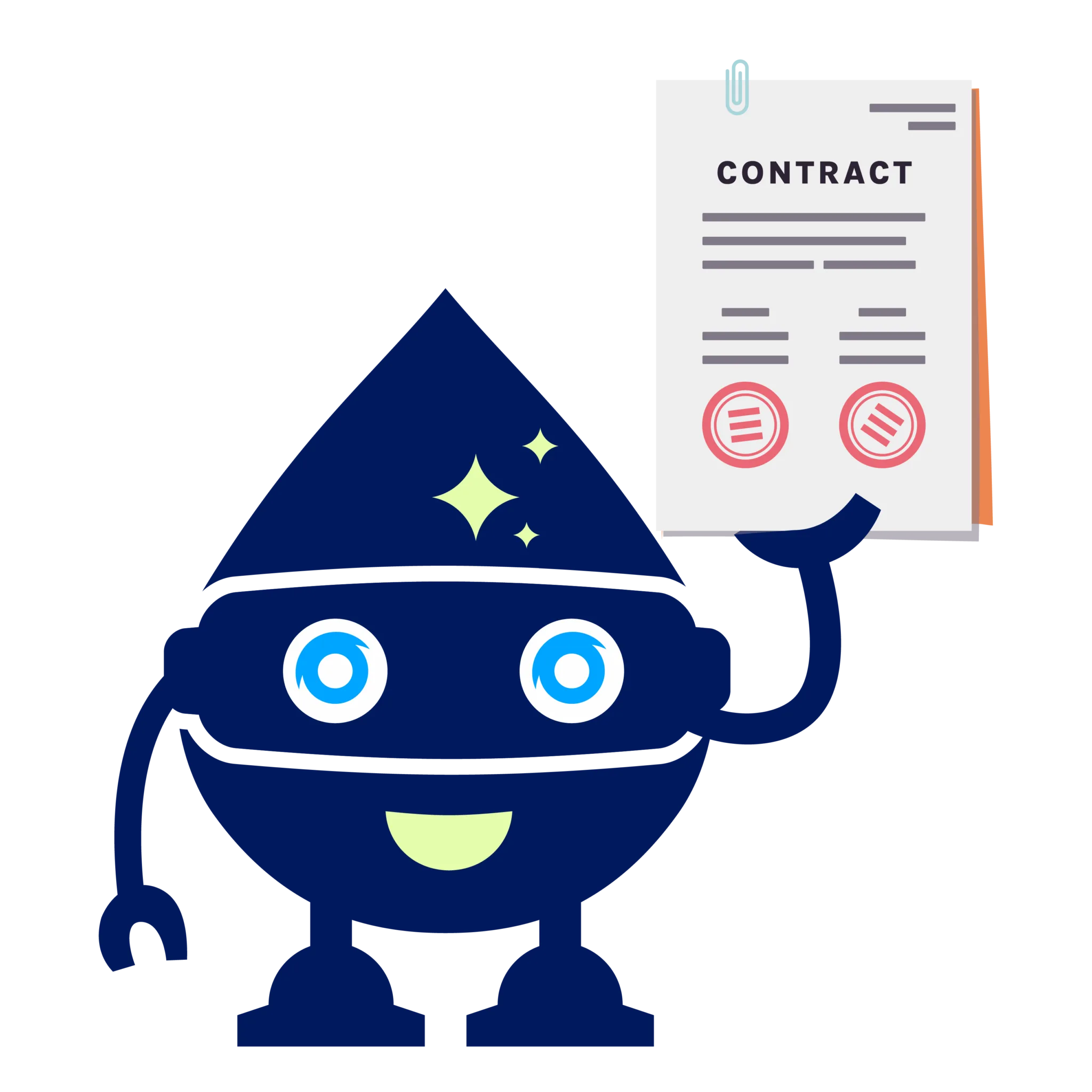
Rain contract 3600px scaled

Key Takeaways

  • Agentic AI in contract management is autonomous. It acts on goals across the full contract lifecycle, not just responds to prompts. A copilot needs you to ask; an agent works when you’re not looking.
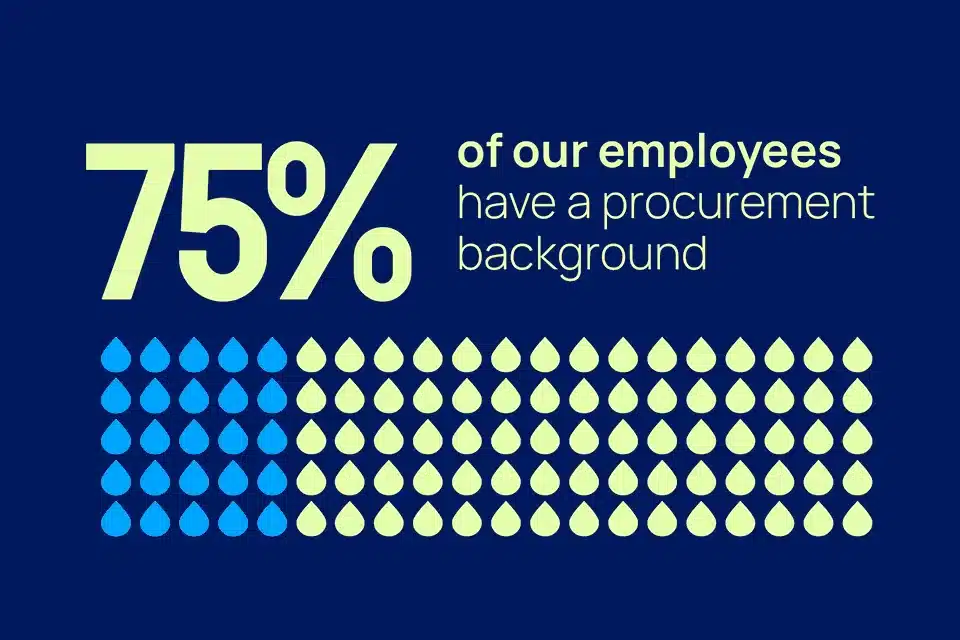
  • It’s measurably different from “AI features” in legacy CLM. Raindrop Systems customers using Rain — our procurement-trained agentic AI — see roughly 95% fewer missed renewals, 75% faster contract review, and near-zero auto-renewal surprises (compared with a 15-20% industry average).
  • Human oversight stays in the loop where it matters. Approval gates, exception review, and playbook governance remain human; low-value review, formatting, and renewal calendar maintenance don’t.

What Is Agentic AI? (Cutting Through the Marketing)

Agentic AI is autonomous AI that plans, acts, and adapts to achieve a goal across multi-step workflows. In contract management, that goal isn’t “answer this question about clause 4.2.” It’s “make sure every commitment we’ve signed gets honored, surfaced, and renewed on our terms.”

Three things separate agentic AI from older AI patterns you’ve seen marketed:

Copilot AI waits for you to ask. You highlight a clause, it suggests an edit. Useful for a single task. Useless when you’re trying to manage 5,000 contracts and don’t know which ones need attention this week.

“AI features” are single-task automations bolted onto legacy CLM. Clause extraction here, sentiment analysis there. Each one works in isolation. None of them know about the others. The vendor calls it AI because the marketing department called it AI.

Agentic AI plans across the lifecycle. It reads a contract, understands the obligations, watches the calendar, notices when a renewal is 90 days out, drafts the renewal language using your playbook, flags any non-standard terms, and notifies the owner — all without anyone prompting it. The difference, as one analyst piece on the Raindrop Systems site explains, is the real difference between AI agents and agentic AI and why it matters for spend management.

Why does the distinction matter? Because if you buy a tool whose “AI” requires you to remember to ask it questions, you’re going to remember the easy questions and miss the hard ones. The hard ones are where the money is.

Agentic vs Autonomous: Why the Words Aren’t Interchangeable

The terms get used as if they’re synonyms. They’re not.

Autonomous = no human in the loop, ever. The AI acts entirely on its own authority. In procurement and contract management, true autonomy is currently aspirational. It’s the destination, not where most teams should be operating today.

Agentic = AI that plans and acts on goals, with human oversight at decision points. The agent monitors, drafts, flags, and routes — but humans approve high-value contracts, investigate exceptions, and govern the playbook. Agentic is the realistic, deployable version of “autonomous.” It’s what you actually want.

A separate Raindrop Systems piece walks through the practical implications: touchless vs autonomous procurement and payables. The short version: touchless and agentic both keep humans in the loop where judgment is required; “autonomous” without qualification is marketing.

What agentic AI does for your contracts

Rain doesn’t just store contracts — it acts on them across the full lifecycle. Here’s what Raindrop Systems customers see versus legacy CLM.

~95%
reduction in missed renewals
~75%
faster contract review
~0
auto-renewal surprises
(vs 15–20% industry avg)

How Agentic AI in Contract Management Works Across the Lifecycle

The lifecycle stages haven’t changed — intake, drafting, review, approval, execution, tracking, renewal. What changes with agentic AI in contract management is who does the work at each stage.

Intake & Drafting — From Scattered Email to Auto-Generated Drafts

A business requester submits an intake form for a new vendor agreement. In a legacy CLM, that form lands in Legal’s inbox. Legal formats it, pulls the right template, fills in standard terms, and — half a day later — sends back a draft.

With Rain, the agent reads the intake the moment it’s submitted. It pulls the relevant clauses from your playbook. It checks the supplier history for any prior agreements. It pre-populates standard terms. It flags any language that deviates from the playbook. Then it routes — to Legal only if a human eye is genuinely needed, or straight to the counterparty for a routine NDA.

The Raindrop Systems personas data shows drafting and routing time compressed by about 78%. Legal stops being the bottleneck on every NDA, MSA, and SOW renewal, and starts spending their time on the contracts that actually matter.

Review & Negotiation — Continuous Risk Scoring, Not Reactive Audit

In a legacy CLM, risk is something you find at audit. Someone in finance pulls a sample of contracts six months after signature, notices a few exclusivity clauses that nobody flagged, and writes a memo.

In an agentic system, risk is scored continuously. Rain compares every incoming contract against your playbook in real time. It quantifies financial risk across the entire contract base. It identifies which agreements deviate from your standards, by how much, and where. When Legal sits down to review a contract, they’re not reading it cold — they’re reading an AI summary that flags exactly the three clauses that need their attention.

The numbers from the Raindrop Systems agentic use case: an AI summary in minutes versus the three to eight hours of legal review per contract that’s common in legacy CLM workflows. Roughly 75% time saved on review cycles. See Rain in action: third-party contract review for a walkthrough of how it works on a real third-party agreement.

Obligation Tracking — The Renewal You’d Otherwise Miss

This is where agentic AI earns its keep. Legacy CLM stores your contracts. You’re still responsible for remembering what’s in them.

Rain monitors every contract’s renewal window, payment terms, SLAs, exclusivity clauses, volume rebates, and scope boundaries. When a renewal is approaching, it doesn’t send a generic calendar reminder. It drafts the renewal terms, surfaces the relevant performance data, and notifies the right owner with context attached.

The outcomes are concrete: roughly 95% fewer missed renewals. Near-zero auto-renewal surprises versus a 15-20% industry average. Cross-contract analysis that flags when the same supplier has two conflicting agreements, or when a clause from one contract contradicts a clause from another.

You renew on purpose, on your terms — not because nobody saw the date coming.

Reporting & Status — Live Dashboard, Not Weekly Meetings

The old way: a procurement analyst spends Monday morning building a contract status report. They pull data from three systems, reconcile it in a spreadsheet, send it to the CPO, and then field questions for the rest of the week.

With agentic AI, the dashboard is live. Rain maintains it continuously. Humans review exceptions — the contracts that need attention this week — not the entire dataset. Roughly 70% of reporting time disappears. The CPO sees commitment risk, renewal exposure, and contract value as a current number, not a Tuesday snapshot.

The Human Oversight Question (What Stays in the Loop)

If you’ve been asking “how much human oversight does agentic AI in contract management require?” — and you should be asking that — the honest answer is: more than vendors marketing “autonomous AI” want to admit, less than skeptics fear.

Agentic doesn’t mean unattended. A well-designed system keeps humans in three places:

  1. Approval gates. Humans approve high-value or non-standard contracts before signature. The agent never approves on its own. It might recommend, draft, route, and surface the relevant context — but the final click on a $5M MSA is still a human decision.
  2. Exception review. Humans investigate anomalies the agent flags: a duplicate supplier showing up in two business units, a clause that conflicts with an existing master agreement, scope creep on an active project. The agent finds the exception; the human decides what to do about it.
  3. Playbook governance. Humans define the clause libraries, approval thresholds, risk rules, and pre-approved templates the agent operates within. The agent doesn’t write its own rules. It enforces yours.

What humans stop doing: low-value review (the hundredth NDA this quarter, a standard SOW renewal), formatting, status reporting, renewal calendar maintenance, manual data pulls for the monthly review.

What humans keep doing: judgment, negotiation strategy, exception handling, playbook evolution, the relationships with strategic suppliers.

If you want a framework for thinking about this, Gartner’s framework for when to use AI agents — and when not to — is a useful starting point. Gartner’s broader 2026 Hype Cycle for Agentic AI positions human oversight as audit-layer governance over routine execution, not step-by-step manual approval — exactly the model agentic AI is designed for. The short version: use agents for high-volume, rule-based, low-risk work; keep humans on judgment-heavy, high-stakes, novel work. The Raindrop Systems perspective on responsible AI for procurement lays out the same boundary in more detail.

“Our team has been using the Raindrop Contract and Sourcing modules for a few years and it has completely transformed our procurement process.”

— Terri Smith, World Market

What Customers Actually See (Real Numbers, Not Predictions)

Vendor blog posts are full of agentic AI predictions for 2027. Here’s what three Raindrop Systems customers see today.

World Market: 75% Efficiency, 90% Spend Under Management

World Market’s procurement team runs contracts and sourcing in one connected workflow on Raindrop Systems. Rain tracks the commitments across both modules — so a contract that comes out of a sourcing event flows straight into obligation tracking, and an invoice that comes against that contract gets matched automatically.

The numbers: 75% efficiency improvement in contract operations. 50% reduction in contract cycle time. 90% of spend now under management. 100% of financial intake captured in the platform. Read the World Market case study for the full implementation.

Workwear Outfitters: 400% ROI on $120M Spend

Workwear Outfitters consolidated contract management with sourcing and supplier management onto a single platform. They now run $120 million in spend under management and report a 400% ROI on the deployment. The ROI breakdown isn’t theoretical: faster cycle times, recovered off-contract spend, and obligations enforced at the invoice level rather than caught in audit. See the Workwear Outfitters case study.

Lands’ End: 4,500 Contracts, 1,300 Specialized Requests Automated

Lands’ End uses Raindrop Systems CLM to manage 4,500 active contracts. Their team automated intake and orchestration for 400 travel requests, 550 capex requests, and 350 renewal requests every year — work that would otherwise consume Legal and Procurement capacity and slow the business down. Read how Lands’ End built smart commitment management with CLM.

These aren’t predictions about what agentic AI might do in 2027. They’re what it does today.

How Agentic AI Differs From “AI Features” in Legacy CLM

When every vendor’s slide deck claims “AI agents,” three evaluation criteria tell the difference. For the deeper architecture argument, see what does AI-native mean in an S2P platform and what agentic AI really means for procurement.

Where the AI Lives

Agentic AI is built into the data model from day one — the platform was designed around an agent operating across the lifecycle. “AI features” bolted onto a legacy CLM are a marketing line over an integration project.

What It Does Between Sessions

Agentic AI works when you’re not looking — renewal monitoring, risk scoring, and conflict detection run overnight, unprompted. Bolted-on AI waits for you to ask. The questions you forget to ask are the ones costing you money.

How It Connects to Procurement

Agentic AI inside a unified Source-to-Pay platform sees sourcing, supplier, invoice, and spend data — so it can match a contract clause to a real invoice automatically. Siloed CLM AI can’t; the data lives in three other systems.

Industry Recognition and Analyst Perspective

The analysts who track this market are paying attention. Raindrop Systems has been named to The Hackett Group’s “50 to Watch” Procurement Technology List — the analyst-curated list of providers reshaping how enterprises buy and manage commitments. Spend Matters has recognized Raindrop Systems as a Customer Favorite for Contract Lifecycle Management, citing the platform’s value beyond technology and its connected approach to source-to-pay.

That recognition matters because the analysts aren’t running our marketing copy. They’re talking to our customers. When customers report outcomes — the kind of numbers above — analysts notice.

The broader market is following the same direction. The Hackett Group’s 2026 Procurement Key Issues study reports that 76% of organizations now see AI-driven improvements of 25% or more in key performance metrics as adoption scales, and 80% of procurement executives identify AI-enabled technology as the single most transformational trend over the next five years. Gartner forecasts that 40% of enterprise applications will feature task-specific AI agents by 2026, up from less than 5% in 2025. The message across analysts is consistent: the platforms moving fastest are the ones that built AI into the data model rather than added it on top.
Raindrop period dark blue

FAQ

What is agentic AI in contract management?

Agentic AI in contract management is autonomous AI that plans and acts on goals across the full contract lifecycle — intake, drafting, review, obligation tracking, renewals, and reporting — with human oversight at decision points. It’s different from copilot AI (which responds to prompts) and from “AI features” (which automate single tasks in isolation). An agentic system watches contracts continuously, surfaces what needs attention, and takes routine actions on its own.

How is agentic AI different from AI features in older CLM tools?

Three differences matter. First, an agentic system is built into the data model — not bolted onto a legacy workflow last quarter. Second, it works between user sessions (renewal monitoring, risk scoring, conflict detection happen automatically), where “AI features” require you to prompt them. Third, agentic AI inside a unified platform sees data across sourcing, supplier management, and AP — so it can match contract terms to real invoices, which siloed CLM AI can’t.

How much human oversight does agentic AI in contract management require?

Agentic doesn’t mean unattended. Humans stay in three places: approval gates (humans approve high-value or non-standard contracts before signature), exception review (humans investigate anomalies the agent flags), and playbook governance (humans define the rules the agent operates within). What goes away: low-value review, formatting, status reporting, manual renewal tracking.

Is autonomous procurement the same as agentic procurement?

No. Autonomous implies no human in the loop, ever — currently aspirational for most procurement work. Agentic means AI that plans and acts on goals with human oversight at decision points. Agentic is the realistic, deployable version of autonomous. When a vendor markets autonomous AI without qualifying it, ask exactly which decisions the AI is making on its own. Usually the answer is none of the important ones, which means it’s agentic, not autonomous.

What ROI can we expect from agentic AI in contract management?

Real customer data is more useful than industry averages. Workwear Outfitters reports a 400% ROI on Raindrop Systems across $120M in managed spend. World Market sees 75% efficiency improvement and 50% cycle time reduction. Lands’ End automates 1,300 specialized requests per year that would otherwise consume Legal and Procurement headcount. The drivers are consistent across customers: faster cycle times, recovered off-contract spend, obligations enforced at the invoice level rather than caught in audit, and a sharp drop in missed renewals.

See agentic AI for contracts in practice.

You can read more vendor blog posts about what agentic AI in contract management might do in 2027. Or you can see what it does in 2026.

SEE THE CLM PLATFORMREQUEST A DEMO