SAP Ariba Alternatives and Competitors in 2026
Buyer’s guide · Updated 2026
If you’re comparing SAP Ariba competitors, the short list worth your time is Coupa (the closest enterprise-scale suite), GEP (one platform across procurement and supply chain), Ivalua (configurable, including direct materials), JAGGAER (complex sourcing, public sector, higher education and healthcare), Zycus (agentic AI across a full suite), Oracle Fusion Cloud Procurement (procurement inside Oracle’s ERP), and Raindrop Systems (a full source-to-pay suite that connects to SAP and non-SAP ERPs, and can run alongside Ariba). Which one fits depends on your ERP, your suppliers, and how much rollout you can staff.
First, what is SAP Ariba? It’s SAP’s source-to-pay software. SAP sells sourcing, contracts and supplier management as SAP Strategic Procurement, and procure-to-pay as SAP Ariba Buying and Invoicing, with suppliers connected through SAP Business Network. SAP says that network links millions of trading partners in roughly 190 countries and carries more than US$7.7 trillion in annual commerce. In March 2026 SAP made next-gen SAP Ariba available, a rebuilt platform on SAP Business Technology Platform with Joule AI built into procurement workflows, and it says more capability arrives through 2026 and into 2027.
This guide compares seven SAP Ariba alternatives, says what each one is genuinely good at, and names the honest trade-off for each. We also cover SAP Ariba vs Coupa, the pairing most buyers start with. We build one of the seven, Raindrop Systems, so you’ll see that entry too. It gets the same treatment as the rest: what it’s good at, and where it isn’t the right fit.

Key takeaways
- ◆The right SAP Ariba alternative depends on your ERP. If you run SAP S/4HANA, Ariba’s SAP-built integration is hard to match. If you run Oracle Fusion, Oracle’s own procurement is the natural comparison. If you run a mix, or NetSuite, Dynamics 365 or Workday, test every vendor’s integration against your actual systems.
- ◆SAP Ariba still fits a specific buyer: an enterprise standardized on SAP, with suppliers already on SAP Business Network and a team to run a large program. For that buyer it remains a strong choice.
- ◆You may not need a replacement at all. Some teams keep Ariba where it works and add intake, contracts or AP around it. Raindrop Systems connects alongside SAP Ariba for that reason. This guide names the trade-off for every option, including that one.
Why Buyers Look Past SAP Ariba
SAP Ariba has real strengths: a business network SAP calls the world’s largest, deep integration with SAP ERP, and a place among the Leaders in Gartner’s 2026 Magic Quadrant for Source-to-Pay Suites, as SAP reports it. Those are the reasons it lands on so many shortlists.
Three things come up most often when procurement and finance teams start evaluating alternatives.
SAP first
Integration built around SAP
SAP says its procurement products can run without SAP ERP and integrate with non-SAP environments, and that Buying and Invoicing supports multiple ERPs. The detail SAP publishes is SAP-to-SAP: two-way supplier sync with SAP ERP, and S/4HANA connections through SAP Integration Suite, managed gateway for spend management (formerly the SAP Ariba Cloud Integration Gateway). If your ledger lives in Oracle, NetSuite, Dynamics 365 or Workday, ask to see the integration pattern for that ERP, and who builds and maintains it.
5 levels
Fees on the supplier side
SAP Business Network gives suppliers a free Standard account. SAP’s supplier pricing page says an Enterprise account may incur a subscription fee and a transaction fee, depending on the volume and value of documents a supplier transacts; SAP sets five subscription levels by that volume, document count and technology usage, and publishes the fee schedule. Suppliers who pay those fees notice them, so ask how many of yours would move to Enterprise accounts under your rollout plan.
2026 to 2027
A platform mid-rebuild
SAP announced next-gen SAP Ariba in October 2025 and made it available on March 12, 2026, describing it as a fundamentally rebuilt platform on SAP Business Technology Platform. SAP says capabilities will keep arriving incrementally through 2026 and into 2027. That brings new AI and tighter ties to SAP Cloud ERP. SAP says current customers can move on a voluntary basis, without commercial implications, and run both environments in parallel. Either way, confirm which capabilities are generally available today and when the rest arrive.
SAP Ariba is still the right call for organizations standardized on SAP whose suppliers already trade on SAP Business Network. The rest of this guide is for teams asking whether there’s a better fit. See how Raindrop Systems compares to SAP Ariba head to head.
SAP Ariba Competitors and Alternatives, Vendor by Vendor
Seven real alternatives, what each is actually good at, and the honest trade-off for each.
Coupa
Best for: Large enterprises that want one spend platform across procurement, finance and supply chain, with a large supplier network.
Coupa says 55% of the Fortune 500 work with it, and its network spans more than 3,500 buyers and 10 million suppliers. In May 2026 it announced the acquisitions of Rossum (invoice document processing) and Tonkean (intake and orchestration). We cover it in depth in our Coupa alternatives guide.
Trade-off: Coupa is a large suite, much like Ariba. Acquis Consulting, a Coupa implementation partner, quotes 12 to 16 weeks for most mid-market deployments and 16 to 24 weeks for enterprise. Leaving Ariba for Coupa trades one large suite for another, so be sure the problem you’re solving is the suite itself.
GEP
Best for: Enterprises that want procurement and supply chain on one platform, including direct materials sourcing.
GEP describes its GEP Quantum Intelligence software as an AI-native platform for procurement and supply chains. It lists intake and orchestration, sourcing, contracts, supplier management, category management, procure-to-pay, third-party risk and supply chain management, and says it ships with more than 1,000 out-of-the-box connectors, including SAP and Oracle.
Trade-off: GEP publishes no pricing and no go-live timeline on its product pages, so you won’t get a cost or time signal until you’re deep in a sales process. Breadth across supply chain is the point; if you only need source-to-pay, you’ll be evaluating more platform than you’ll use.
Ivalua
Best for: Large enterprises with complex categories, including direct materials, that want to shape the platform to their own processes.
Ivalua covers indirect goods, services, direct materials and complex categories in one procurement platform, with intake, sourcing, contracts, supplier management, eProcurement and AP automation. It pairs pre-packaged practices with no-code and low-code flexibility on a single code base, and says more than 500 organizations use it.
Trade-off: Flexibility means design decisions. The more you configure, the more your team or a partner has to define and maintain. Ivalua doesn’t publish an implementation timeline, so ask for one built on your scope.
JAGGAER
Best for: Manufacturing, public sector, higher education and healthcare buyers with complex, regulated sourcing.
JAGGAER positions itself as procurement software for complex sourcing, supply and spend, with source-to-contract, procure-to-pay, supply chain collaboration and AP automation. Its public sector offering covers central government, education, nonprofits, emergency services and healthcare. Vista Equity Partners announced its acquisition of JAGGAER in August 2024, citing more than 1,400 customers.
Trade-off: JAGGAER’s pitch is aimed at manufacturing and public sector buyers, where it lists multi-round sourcing optimization and audit trails. If your sourcing is simpler than that, that depth won’t shorten your path to value elsewhere in the platform.
Zycus
Best for: Procurement teams that want agentic AI across a full source-to-pay suite.
Zycus calls its platform the only source-to-pay platform built for autonomous procurement. Its Merlin agents handle intake, negotiation and analytics across eProcurement, eInvoicing, sourcing, contracts and supplier management. Zycus says 500+ enterprises run on it and lists itself as a Leader in Gartner’s 2026 Magic Quadrant for Source-to-Pay Suites.
Trade-off: Zycus lists a Supplier Network among its products but publishes no size for it, so ask how many of your suppliers it already reaches and how many would need to onboard. Zycus also doesn’t publish a deployment timeline, so ask for one built on your scope.
Oracle Fusion Cloud Procurement
Best for: Companies already running Oracle Fusion ERP that want procurement from the same vendor.
Oracle Fusion Cloud Procurement covers sourcing, contracts, purchasing, self-service procurement and supplier management, and sits inside Oracle’s Fusion ERP applications. Oracle says built-in AI and agentic applications help teams manage sourcing, contracts and spend.
Trade-off: The case for Oracle is the same as the case for Ariba, turned around: it’s strongest when Oracle is your ERP. If it isn’t, you’re trading one ERP vendor’s procurement for another’s.
We build this one
Raindrop Systems
Best for: Mid-market to large enterprise teams that want a full source-to-pay suite on SAP or non-SAP ERPs, or want to extend Ariba without ripping it out.
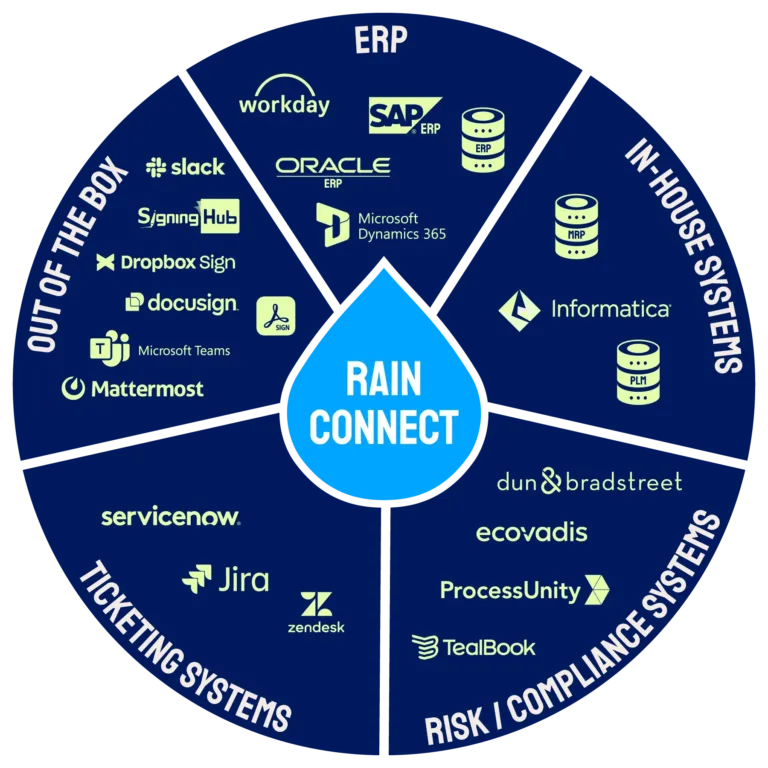
Raindrop Systems is a full source-to-pay platform: intake and orchestration, sourcing, contract lifecycle management, supplier management, eProcurement, AP automation, e-invoicing and RainPay on one platform. It connects through RainConnect, its built-in integration layer, to SAP S/4HANA and older ECC instances, alongside SAP Ariba where it’s already in place, and to NetSuite, Oracle, JD Edwards, Microsoft Dynamics 365 and Workday. Supplier access carries no fees.
On deployment, a single module can go live in as little as one week, and the full source-to-pay suite takes 8 to 16 weeks. Raindrop Systems is a Sample Vendor in the 2026 Gartner Hype Cycle for Procurement and Sourcing Solutions.
Trade-off, honestly: Raindrop Systems is a much smaller company than SAP, and it has no network on the scale of SAP Business Network. If you’re standardized on S/4HANA and your suppliers already transact on SAP Business Network, Ariba’s SAP-built integration is hard to beat.
How the Alternatives Compare
Every platform trades something for something else. Deployment speed is as each vendor or its implementation partner states it; most vendors here, SAP included, don’t publish a figure at all, which is itself useful information for a shortlist.
| Platform | Best for | Deployment speed | Notable trade-off |
|---|---|---|---|
| SAP Ariba | SAP-standardized enterprises with suppliers on SAP Business Network | Not publicly stated | Possible supplier fees on Enterprise accounts; platform mid-rebuild |
| Coupa | Large enterprises wanting one spend platform | 12 to 16 weeks mid-market, 16 to 24 enterprise (Coupa partner Acquis Consulting) | Enterprise scope, like Ariba |
| GEP | Procurement and supply chain on one platform | Not publicly stated | No published pricing or timeline |
| Ivalua | Complex categories, including direct materials | Not publicly stated | Configuration choices to define and maintain |
| JAGGAER | Public sector, higher ed, healthcare, manufacturing | Not publicly stated | Depth built for complex, regulated sourcing |
| Zycus | Agentic AI across a full suite | Not publicly stated | Supplier network size not published |
| Oracle Fusion Cloud Procurement | Companies on Oracle Fusion ERP | Not publicly stated | Strongest when Oracle is your ERP |
| Raindrop Systems | Mid-market to large enterprise, SAP or non-SAP ERP, or alongside Ariba | Single module in as little as 1 week; full suite 8 to 16 weeks | Much smaller company than SAP |
SAP Ariba
Best for: SAP-standardized enterprises with suppliers on SAP Business Network
Deployment speed: Not publicly stated
Notable trade-off: Possible supplier fees on Enterprise accounts; platform mid-rebuild
Coupa
Best for: Large enterprises wanting one spend platform
Deployment speed: 12 to 16 weeks mid-market, 16 to 24 enterprise (Coupa partner Acquis Consulting)
Notable trade-off: Enterprise scope, like Ariba
GEP
Best for: Procurement and supply chain on one platform
Deployment speed: Not publicly stated
Notable trade-off: No published pricing or timeline
Ivalua
Best for: Complex categories, including direct materials
Deployment speed: Not publicly stated
Notable trade-off: Configuration choices to define and maintain
JAGGAER
Best for: Public sector, higher ed, healthcare, manufacturing
Deployment speed: Not publicly stated
Notable trade-off: Depth built for complex, regulated sourcing
Zycus
Best for: Agentic AI across a full suite
Deployment speed: Not publicly stated
Notable trade-off: Supplier network size not published
Oracle Fusion Cloud Procurement
Best for: Companies on Oracle Fusion ERP
Deployment speed: Not publicly stated
Notable trade-off: Strongest when Oracle is your ERP
Raindrop Systems
Best for: Mid-market to large enterprise, SAP or non-SAP ERP, or alongside Ariba
Deployment speed: Single module in as little as 1 week; full suite 8 to 16 weeks
Notable trade-off: Much smaller company than SAP
Every "not publicly stated" cell above means exactly that: we found no specific deployment timeframe on the vendor’s own product pages as of October 2026. Ask for one in writing, built on your scope, during the demo.
SAP Ariba vs Coupa, and the Third Option
If your shortlist has narrowed to SAP Ariba or Coupa, the deciding factor is usually your ERP. Both say Gartner named them Leaders in its 2026 Magic Quadrant for Source-to-Pay Suites. Ariba’s edge is SAP itself: SAP builds and documents the connections to S/4HANA and keeps supplier records in two-way sync with SAP ERP. Coupa’s pitch is one platform across procurement, finance and supply chain, with a network it puts at more than 3,500 buyers and 10 million suppliers, plus its 2026 additions for invoice processing and intake. Neither publishes suite pricing; SAP lists a price only for Strategic Procurement. If you run S/4HANA, start with Ariba’s integration story. If you run a mix of ERPs, put both through the same integration test. Our Coupa alternatives guide covers the Coupa side in depth.
The third option
Worth putting on the table before you commit to either: do you need to replace Ariba at all? Both are large suites with large programs behind them. If Ariba sourcing works and the pain is intake, contracts or AP, Raindrop Systems connects alongside SAP Ariba and S/4HANA, so you extend what works instead of ripping it out. If the whole suite is the problem, Raindrop Systems is also a full source-to-pay replacement. See the head-to-head comparison.
Decision Framework: What to Ask, By Role

CFO or controller
Ask for three-year total cost at your real volumes, with modules, implementation services and integration work broken out as separate lines. Ask for the go-live timeline in writing, since most vendors here don’t publish one. Ask how supplier network fees might show up in your suppliers’ pricing.
Procurement lead
Ask to watch a purchase request become a paid invoice, live. Ask how many of your suppliers would move to a network account that may carry fees, and what onboarding looks like for the ones who won’t sign up. Ask whether contract terms are visible when the invoice is matched.
IT and security
Ask for the integration pattern for your exact ERP (native connector, SAP Integration Suite, other middleware, or files) and who owns it once live. If you’re on Ariba today, ask what moving to next-gen SAP Ariba would involve and how it fits your timeline. Ask about SSO, audit logs and security attestations such as SOC 2 Type II.

Legal or compliance
Ask how existing contracts, clause libraries and approval history migrate. Ask which e-invoicing mandates are covered in the countries you invoice in, and what the audit trail records for approvals and changes.
When SAP Ariba Is Still the Right Choice
SAP Ariba is the right platform for a specific buyer: an enterprise standardized on SAP S/4HANA that wants SAP-built integration, whose suppliers already trade on SAP Business Network, and that can staff a large program. SAP says the network links millions of trading partners in roughly 190 countries, supports e-invoicing compliance in more than 40 countries, and that Gartner named SAP a Leader in its 2026 Magic Quadrant for Source-to-Pay Suites. If that describes your organization, the trade-offs in this guide are ones you’ve likely already priced in. The teams this guide helps most are the ones running a mixed ERP estate, or whose real pain sits in intake, contracts or AP.
Frequently Asked Questions
SAP Ariba is SAP's source-to-pay software. SAP sells sourcing, contracts and supplier management as SAP Strategic Procurement (SAP Ariba Sourcing, SAP Ariba Contracts and SAP Ariba Supplier Lifecycle and Performance), and procure-to-pay as SAP Ariba Buying and Invoicing, with guided buying, catalogs and invoice management. Buyers and suppliers connect through SAP Business Network, which SAP says carries more than US$7.7 trillion in annual commerce.
It's still SAP Ariba. SAP sells it as part of its spend management portfolio, and in March 2026 it made next-gen SAP Ariba available, rebuilt on SAP Business Technology Platform. Two related names did change: the Ariba Network is now SAP Business Network, and the SAP Ariba Cloud Integration Gateway is now SAP Integration Suite, managed gateway for spend management and SAP Business Network.
In the SAP Ariba alternatives and competitors results we checked in October 2026, Coupa appeared most often, followed by Ivalua and JAGGAER. GEP, Zycus, Oracle Fusion Cloud Procurement and Workday also appeared in several. Most of those results are review sites and vendor-written pages, and we read some only as search listings, so treat the ranking as a sign of who gets compared, and read each vendor's own pages for specifics.
Neither is better for everyone. Both say Gartner named them Leaders in its 2026 Magic Quadrant for Source-to-Pay Suites. SAP Ariba usually fits best when SAP S/4HANA is your ERP, because SAP builds those connections. Coupa positions itself as one platform across procurement, finance and supply chain. With a mixed ERP estate, run both through the same integration test before you decide.
SAP publishes one list price: SAP Strategic Procurement at USD 2,420 a month per user, on 3 to 36 month terms, with add-ons priced on request. Pricing for SAP Ariba Buying and Invoicing isn't listed, so you'll need a quote. On the supplier side, a Standard SAP Business Network account is free, and an Enterprise account may incur a subscription fee and a transaction fee, depending on the volume and value of documents the supplier transacts. Ask for three-year total cost, including services.
SAP says yes. Strategic Procurement can run without SAP ERP and integrate with non-SAP environments, and Buying and Invoicing supports multiple ERPs and offers an open APIs framework. Most of the integration detail SAP publishes covers SAP backends such as S/4HANA, so ask to see the pattern for your ERP and who maintains it.
No. SAP announced next-gen SAP Ariba in October 2025 and made it available in March 2026, with more capabilities arriving through 2026 and into 2027. SAP says existing customers can move to next-gen on a voluntary basis, without commercial implications, and run both environments in parallel during the transition.
Yes. Raindrop Systems connects alongside SAP Ariba where it's already in place, and to SAP S/4HANA and older ECC instances, through RainConnect. Teams can keep Ariba for what works and add intake, contracts or AP automation around it, or replace the suite entirely. A single module can go live in as little as one week, and the full suite takes 8 to 16 weeks.
Get a straight answer on fit
If you’re weighing SAP Ariba alternatives and want a straight answer on whether Raindrop Systems fits your ERP, your suppliers and your timeline, talk to a specialist. You’ll get a real answer about fit, including when staying on Ariba is the better choice.
Keep reading
- ◆Raindrop Systems vs SAP Ariba: the head-to-head comparison, difference by difference.
- ◆Coupa Alternatives: the companion guide for teams weighing the other large suite.
- ◆ERP Integrations for Procurement and AP: how RainConnect connects to SAP, Oracle, Dynamics 365, NetSuite and Workday.