
SYNC THE STORM
Raindrop Integrates Anywhere
The AI-native integration layer for Source-to-Pay. Built in from day one, not bolted on.
Having everyone and every system work together should be the easiest part of transforming procurement. For most organizations, it is the hardest. Procurement and finance teams run a complex ecosystem of ERPs, AP platforms, contract tools, and supplier networks. Traditional integrations between them are slow, expensive, and fragile.
Raindrop Systems changes the math. Built as an AI-native Source-to-Pay platform with intelligent orchestration at its core, Raindrop connects across your existing systems through RainConnect, our integration and connectivity layer. Instead of stitching systems together after the fact, the platform enables real-time, automated workflows across your entire stack from day one.
The result for CFOs, CPOs, and IT leaders: move faster, see more, control better, without a rip-and-replace ERP project.
What Changes When Raindrop Is Your Integration Layer
The numbers below come from production deployments at Raindrop customers integrating with SAP, JD Edwards, and Microsoft Dynamics 365. Benchmark ranges reference APQC, Ardent Partners, and Hackett Group research.
~85%
FASTER
5-8 days to 4-8 hours
Supplier onboarding
~80%
REDUCTION
$12-$30 to $2-$5
Invoice processing cost
~75%
FASTER
14-30 days to 3-7 days
Procure-to-pay cycle
~80%
REDUCTION
15-25% to 3-5%
Invoice exception rate
100%
ELIMINATED
10-20% to ~0%
Duplicate / mismatched records
0s
LAG
48-72 hrs to real-time
Supplier deactivation lag
ANALYST RECOGNITION · IDC 2025
“RainConnect’s advantage lies in its elimination of most integration friction. It combines modern, no-code/low-code configuration for typical connections with rapid deployment, a differentiator in a market that too often expects long consulting cycles.”
Patrick Reymann
Research Director, Procurement and Enterprise Applications, IDC
RainConnect: Universal Connectivity Without the Consulting Army
RainConnect is the Raindrop integration and connectivity layer. It is not a separate product bolted on after go-live. It is part of the core platform from day one.
Universal Connectivity
Deployment in weeks, not quarters. A single module can go live in as little as one week; a full source-to-pay deployment typically takes 2 to 3 months. Pre-built connectors reach the ERPs, AP platforms, and supplier networks below.
Your Central Data Hub
RainConnect consolidates data across procurement, finance, and supplier systems into a single operational view. Every supplier, PO, invoice, and payment, reconciled in real time, visible from one interface.
No Consultants Required
Business users configure most connections through a low-code interface powered by Workato. IT owns access, security, and governance, not day-to-day integration plumbing. No consulting army, no line item.
SIX CAPABILITIES, ONE ARCHITECTURE

AI-Native Integration Layer
Integrations are built into the core from day one, with AI interpreting unstructured data, resolving exceptions, and routing work across systems automatically.
Pre-Built Connectors
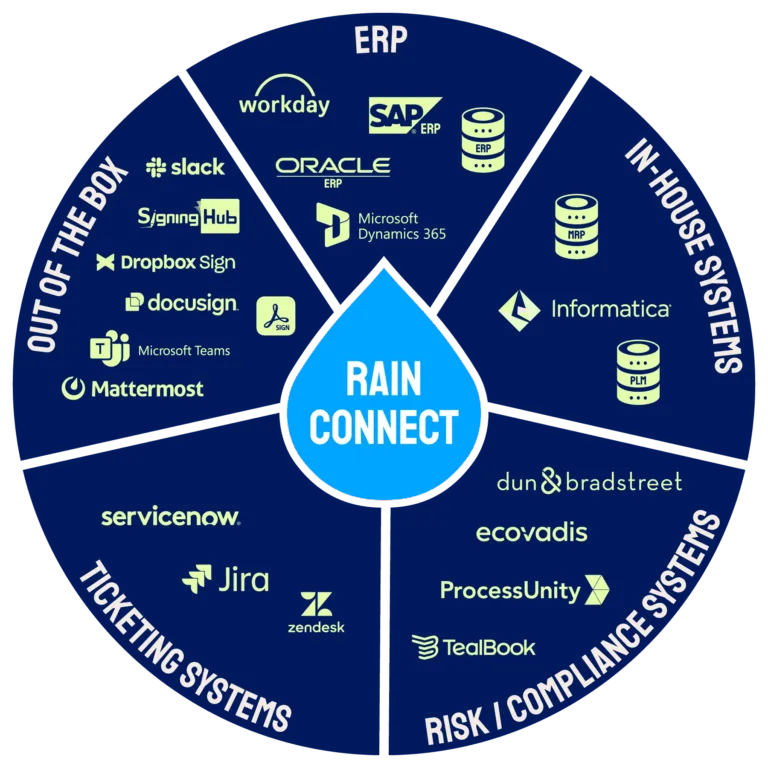
Standard connectors for SAP, Microsoft Dynamics 365, Oracle, JD Edwards, Epicor, DocuSign, Adobe Sign, Slack, Microsoft Teams, and major supplier networks.
Real-Time Data Sync
Bi-directional sync for the workflows that need it: approvals, invoice status, supplier updates, deactivations. Batch mode for the workflows that do not.
Low-Code / No-Code Configuration
Powered by Workato, the enterprise-grade iPaaS layer underneath RainConnect. Business users configure most integrations without writing code. IT defines the guardrails.
Intelligent Orchestration
Raindrop does not just exchange data. It orchestrates processes. One intake, one outcome, zero handoffs across systems.
Scalable Architecture
Built on Google Cloud for enterprise-grade performance, 99.99% uptime, and elastic scale. Security, reliability, and compliance inherit from Google’s infrastructure.
AND WE MEAN ANYWHERE
NoT LISTED? Raindrop can STILL INTEGRATE WITH IT.
If a system your team runs is not listed, RainConnect’s connector architecture is built to reach beyond this list, so ask directly.
ERP and Financial Systems
The systems of record most procurement teams live inside every day.
- NetSuite: Push POs, receipts, and invoice status back into NetSuite without a custom build.
- SAP ERP (S/4HANA and ECC): Certified connections reach both current S/4HANA and older ECC instances.
- SAP Ariba: Connects alongside SAP Ariba where it is already in place, instead of forcing a rip-out.
- Oracle ERP, Oracle Fusion, and JD Edwards: Covers Oracle’s current cloud line and the JD Edwards EnterpriseOne installs still common in manufacturing and distribution.
- Microsoft Dynamics 365: Bi-directional sync for approvals, invoice status, and supplier records.
- Microsoft Great Plains: Reaches organizations still running Great Plains alongside newer Dynamics 365 instances.
- Workday: Connects procurement and AP workflows to Workday’s financial management modules.
- Any ERP: Raindrop’s connector architecture is built to reach ERPs beyond this list. If your instance is not named here, ask what the connection actually looks like.
In-House and Manufacturing Systems
The systems built or customized in-house that most procurement vendors ignore.
- MRP systems: Materials requirements planning data flows into procurement without a manual export step.
- PLM systems: Product lifecycle management data informs sourcing and supplier decisions upstream.
- Informatica: Data integration and governance pipelines connect rather than duplicate.
Signature and Collaboration Tools
The tools your team already uses for approvals, signatures, and day-to-day communication.
- DocuSign: Signed contracts return to the platform automatically with version control intact.
- Adobe Sign: A second native eSignature path for teams standardized on Adobe’s tools.
- SigningHub: Reaches organizations running SigningHub for regulated or region-specific signature workflows.
- Dropbox Sign: Connects for teams using Dropbox Sign as their signature tool of record.
- Slack: Approval requests, exceptions, and status updates route to Slack instead of getting buried in email.
- Microsoft Teams: The same notifications and approval routing for teams standardized on Teams.
- Mattermost: A self-hosted collaboration option for security-conscious IT teams.
Ticketing and Service Management
Where IT and shared services already track work.
- ServiceNow: Procurement requests and exceptions can route through ServiceNow’s existing ticketing structure.
- Jira: Connects for teams running procurement operations alongside engineering or IT workflows in Jira.
- Zendesk: Reaches shared services teams using Zendesk for internal support tickets.
Risk and Compliance Data
Third-party data that feeds supplier risk and ESG scoring directly into the platform.
- Dun & Bradstreet: Financial risk and business data feed supplier scoring without a manual lookup.
- EcoVadis: ESG and sustainability ratings connect directly to supplier records.
- ProcessUnity: Third-party risk management data flows into the same supplier view.
- TealBook: Supplier data enrichment connects to keep supplier master records current.
Built for Your ERP, Whichever One You Run
Every ERP creates a different integration reality. Raindrop connects to each of the following with a real, maintained path, not a generic promise.
NetSuite
NetSuite customers get bidirectional sync for POs, receipts, invoices, and vendor records, so AP automation and procurement decisions stay current against the system of record instead of a nightly export.
Sage
Raindrop connects with Sage environments to keep invoice coding, approvals, and payment status synchronized without a parallel spreadsheet tracking what the ERP does not yet show.
Oracle, Oracle Fusion, and JD Edwards
Oracle’s cloud financial modules and JD Edwards EnterpriseOne installations are common in manufacturing and connect natively, supporting organizations running either the current cloud line or a long-standing on-premise instance.
SAP Ariba and SAP S/4HANA
Raindrop reaches both SAP’s sourcing side (Ariba) and its core ERP (S/4HANA), so teams with SAP already in place extend it rather than replace it.
Microsoft Dynamics 365
Approvals, invoice status, and supplier updates sync bidirectionally with Dynamics 365’s financial management modules.
Microsoft Great Plains
Organizations still running Great Plains, often alongside a newer Dynamics 365 instance during a phased migration, get the same connected workflow.
Workday
Workday’s financial management modules connect to procurement and AP workflows, so approvals and payment data move without a manual reconciliation step.
Not seeing your ERP above? Raindrop’s connector architecture is built to reach systems beyond this list. The conversation with our team starts with what RainConnect can reach in your specific environment, not a fixed menu.
Implementation Timing: Weeks, Not Years
Legacy source-to-pay rollouts routinely run 8 to 12 months before a single module goes live. Raindrop’s architecture was built to avoid that timeline entirely, not shave a few weeks off it.
A single module, in the fastest deployments. Module scope varies enough that this is the fast case, not a typical or average figure.
A full Source-to-Pay suite deployment, 8 to 16 weeks end to end.
What legacy suite rollouts typically take, per industry benchmarks. This is the comparison Raindrop’s architecture is built against.
From Integration to Orchestration: The Distinction That Matters
Every procurement supplier claims integration. Most mean the same thing: data moves between systems on a schedule. Suppliers get synced overnight. Invoices get pushed in batches. Payment status updates in the morning.
That is not integration. That is data transfer with extra steps.
Real integration does three things the legacy model does not:
Unified data model. RainConnect creates a single view of your supplier, PO, invoice, and payment data, not three copies drifting out of sync. When a supplier’s banking details change in the ERP, they are corrected in the Raindrop platform instantly. When an invoice is approved in the platform, the ERP sees the match before the AP team does.
Process orchestration across systems. Intake in the platform triggers validation, routes through approvals, pushes to the ERP, and confirms activation, all without a human handoff. You do not integrate systems; you orchestrate work that happens to cross them.
Context-aware decisioning. AI adds judgment, not just routing. Rain interprets an unstructured invoice, flags a mismatch against the PO, and suggests a resolution. Your team reviews the edge cases. The rest moves on its own.
Integration moves data.
Orchestration moves work.
Most legacy P2P suites give you the first. Raindrop gives you both.
VALUE BY ROLE
Procurement & Finance
- $12-$30 to $2-$5 · invoice processing cost
- 14-30 days to 3-7 days · P2P cycle time
- ~65% reduction · AP exception touchpoints
- Near zero · duplicate payment risk
- +1-2% of spend · early pay discount capture
Business Stakeholders
- Same day or next day · request-to-approval time
- Live tracking · status visibility, no chasing
- ~80% reduction · rework from incomplete requests
- Hours, not days · new supplier transact-ready
IT & Security
- Eliminated · shadow procurement
- 48-72 hrs to real-time · supplier deactivation sync
- Full structured log · combined audit trail
- Fewer users · direct ERP access burden
Executives
- All suppliers & entities · real-time spend visibility
- $500k-$1M/yr · early pay savings at $50M spend
- $175k-$650k/yr · processing cost reduction (25k invoices)
- Phased · no rip-and-replace ERP risk
- Clean data foundation · risk, ESG, spend AI readiness
Customer Proof
Named deployments where RainConnect handles the integration layer.
Buckman Chemical
SAP supplier onboarding integration
- Cycle time: 5-8 days to 4-8 hours per new supplier
- Error rate: 10-20% to ~1%
- Compliance audit prep: ~70% faster
- Bi-directional activation/deactivation sync
Cordis
JD Edwards AP integration
- Invoice processing cost: $12-$30 to $2-$4
- P2P cycle time: 14- 30 days to 3-7 days
- AP staff time on exceptions: ~60% reduction
- JDE remains the system of record for payments
Mid-market healthcare group
Microsoft Dynamics 365 invoice & payment integration
- Vendor master sync eliminated 10-20% stale record rate
- Light MVP setup delivered AP efficiency gains inside 90 days
- Full 3-way match phase unlocking next
- No rip-and-replace ERP project required
Analyst Recognition
RainConnect Integration Recognition
Analyst Patrick Reymann cited Raindrop’s “elimination of most integration friction” and “rapid deployment” as market differentiators.
“50 to Watch” Procurement Technology
Named to the Hackett Group’s “50 to Watch” Procurement Technology List. Ongoing collaboration with Hackett on AI agents and future operating models.
Fall 2025 SolutionMap Customer Favorite
Recognized as a customer favorite for intake and orchestration and supplier management across Fall 2025 SolutionMap cycles.
See the Integration Layer in Each Module
RainConnect is the layer underneath every Raindrop module. See how the integration layer shows up in practice: AP Automation pushes approved invoices straight through to your ERP or pays directly through RainPay, while E-Invoicing feeds structured, matched invoice data into AP before a human ever touches it.
FAQ
A single module can go live in as little as 1 week; a full Source-to-Pay deployment typically takes 2 to 3 months (8 to 16 weeks). Module timing varies with scope, so treat 1 week as the fast case rather than a typical figure. Both numbers compare against the 8 to 12 months a legacy suite rollout usually takes.
No. RainConnect integrates with the ERP you already run, whether that is NetSuite, SAP, Oracle, Dynamics 365, Workday, Sage, or another system. There is no rip-and-replace ERP project. Your ERP stays the system of record; Raindrop reads from it and writes back to it.
NetSuite, Sage, Oracle (including Oracle Fusion and JD Edwards), SAP Ariba, SAP S/4HANA, Microsoft Dynamics 365, Microsoft Great Plains, and Workday all have maintained connections today. Raindrop's connector architecture is also built to reach ERPs beyond this list, so ask directly if yours is not named here.
Machine learning auto-codes non-PO invoices, such as subscriptions, services, and one-off purchases, using historical coding patterns and your GL rules instead of routing them to a person's inbox to guess at.
RainConnect is built into the core Raindrop platform from day one, not a separate product bolted on after go-live. Business users configure most connections through a low-code interface powered by Workato, and IT owns access, security, and governance rather than day-to-day integration plumbing.
Minimal IT involvement is required day to day. Most configuration happens through the low-code interface. IT typically supports initial access, security validation, and governance, but ongoing management does not depend on a consulting engagement or dedicated integration developers.
Both, configurable per workflow. Approvals, invoice status, supplier updates, and deactivations can run in real time. Other data processes can run on a schedule when real-time sync is not needed. You choose the mode per workflow, not per platform.
Traditional middleware stitches systems together after the fact and still leaves your team reconciling data manually. Raindrop provides a unified data model through RainConnect, orchestrates processes across systems rather than just passing data, and adds AI context and decisioning instead of routing alone.
Yes. The Raindrop platform is built with enterprise-grade security and governance: role-based access controls, secure API communication, full audit trails across transactions and workflows, and compliance inherited from Google Cloud infrastructure.
Yes. The platform's modular, API-first architecture lets integrations evolve as your stack changes. You can swap ERPs, add tools, or expand functionality without rebuilding the entire integration layer from scratch.
Ready to Transform Your Data Integration?
Integrations should not be a project. They should be a capability that is already working the day your team logs in. If you are evaluating whether to extend your current stack or rip-and-replace it, the conversation starts with what RainConnect can reach and how fast. Most teams are surprised by both.