
Tipalti Alternatives and Competitors in 2026
Buyer’s guide · Updated 2026
If you’re evaluating Tipalti alternatives, the short list worth your time is BILL (broad accounting sync at per-user pricing), AvidXchange (US mid-market AP with a payments network), Stampli (invoice and procurement workflow on top of your ERP), Ramp (AP inside a card and spend platform), Coupa (payables inside an enterprise spend suite), Airbase (now part of Paylocity), and Raindrop Systems (a full Source-to-Pay (S2P) suite where AP connects to intake, contracts and purchasing). Which one fits depends on whether your problem is payment reach, cost at your volume, or an AP process that keeps breaking upstream.
First, a quick answer to what is Tipalti. Tipalti is a finance automation platform, founded in 2010, that covers accounts payable, mass payments, procurement, expenses and treasury. Its core strength is paying people across borders: Tipalti says it reaches 200+ countries and territories in 120 currencies, with tax-form collection and multi-entity AP built in. Buyers who compare Tipalti competitors usually have a narrower question: what the total cost looks like at their volume, how far the suite reaches beyond payables, or what is going wrong upstream of the invoice.
This guide compares seven Tipalti alternatives, tells you what each one is genuinely good at, and names the honest trade-off for each. We also cover Tipalti vs Bill.com, the pairing most buyers start with. We build one of the seven, Raindrop Systems, so you’ll see that entry too. It gets the same treatment as the rest: what it’s good at, and where it isn’t the right fit.

Key takeaways
- ◆The right Tipalti alternative depends on what is driving the search. If your suppliers are mostly domestic, BILL, AvidXchange and Stampli are built for that. If you want AP inside a card and expense platform, look at Ramp. If your AP trouble starts in intake, contracts or purchasing, a Source-to-Pay suite like Raindrop Systems addresses the cause.
- ◆Tipalti still fits a specific buyer: companies paying many suppliers or payees across borders, with tax-form collection and multi-entity accounting built into the payment flow. That is the job it was built for, and it remains a strong choice for it.
- ◆No alternative gives you everything. Each one trades something (payment reach, price predictability, or suite breadth) for something else (speed, cost, or simplicity). This guide names the trade-off for each one.
Why Buyers Look Past Tipalti
Tipalti has real strengths: payments to 200+ countries and territories, supplier self-service onboarding, multi-jurisdictional tax compliance, and AP across multiple entities from one system, backed by money transmitter licenses in the US, Canada, the UK and the EU. Those are the reasons it lands on so many shortlists.
Three things come up most often when finance teams start evaluating alternatives.
Payables first
Payables-first scope
Tipalti describes its suite as accounts payable, mass payments, procurement, expenses and treasury, and it sells procurement, expenses and treasury as add-on modules to the payables core. The Procurement module covers intake management, PO management and approval workflows; sourcing and contract lifecycle management are not on the list. If your late invoices and approval gaps trace back to contracts nobody can find at invoice time, or to suppliers chosen outside any system, the cause sits upstream of anything a payables suite controls.
$99/mo + fees
Pricing that scales with volume
Tipalti publishes entry points: Accounts Payable plans start at $99 a month and Mass Payments plans at $249 a month, both with unlimited users. Transaction pricing per invoice and per payment is charged on top, and Tipalti notes that more complex environments may need additional professional services. That model suits plenty of teams. It also means your real cost is a calculation you can’t finish from the pricing page, so ask for a quote built on your own invoice and payment volumes.
Funded accounts
Where payment funds sit
Tipalti’s FAQ says you can keep your current corporate bank accounts, and that payments are funded either through a virtual account with Tipalti or through a limited dedicated bank account in your company name with Tipalti’s banking partner. For teams that want payments to leave from their own bank relationships, or whose treasury and security reviewers have views on where funds sit, that is a design decision to evaluate early. For teams that need a licensed network to reach payees in many countries, it is a reasonable trade.
Tipalti is still the right call for companies that pay many suppliers or payees across borders and want tax compliance and onboarding built in. The rest of this guide is for teams asking whether there’s a better fit. See how Raindrop runs AP and procurement inside NetSuite.
Tipalti Competitors and Alternatives, Vendor by Vendor
Seven real alternatives, what each is actually good at, and the honest trade-off for each.
BILL
Best for: Finance teams that want AP and AR in one place, broad accounting-software sync, and per-user pricing they can model in advance.
BILL publishes plan prices of $49, $65 and $89 per user per month (Essentials, Team and Corporate), plus a custom-priced Enterprise plan that adds two-way sync with Oracle NetSuite, Sage Intacct and Microsoft Dynamics, multi-entity and multi-location accounting, SSO and API access. BILL reports a network of more than 4 million vendors and supports international payments in more than 130 countries.
Trade-off: Per-user pricing grows with every approver you add (BILL lists discounts for approver-only users), while Tipalti’s published plans include unlimited users. The NetSuite, Sage Intacct and Dynamics sync sits in the custom-priced Enterprise plan, and BILL’s 130+ country reach is narrower than the 200+ Tipalti publishes. If most of your payees are domestic, that gap may never matter.
AvidXchange
Best for: US mid-market companies, especially in real estate, construction, healthcare and similar industries, that want AP automation and supplier payments backed by a large accounting-system integration library.
AvidXchange describes itself as a provider of AP automation software and payment solutions for middle market businesses and their suppliers, and it lists 240 accounting-system integrations. TPG and Corpay completed their acquisition of the company in October 2025, taking it private at a valuation of about $2.2 billion.
Trade-off: AvidXchange’s own comparison material says its payments focus more heavily on domestic supplier payment automation, so a payee base spread across many countries is where to test it hardest.
Stampli
Best for: Teams that want to keep their ERP as the system of record and add invoice, procurement and payment workflow on top, with pre-built connections to NetSuite, Sage Intacct, SAP, Microsoft Dynamics, Oracle Fusion and QuickBooks.
Stampli positions itself as a Procure-to-Pay platform covering procurement, accounts payable, vendor management, payments and expense management. It says its implementation approach lets you deploy in weeks. Tipalti, for comparison, cites an average four-week go-live.
Trade-off: Stampli’s own payments page describes international payments as subject to product availability and configuration, so confirm country and currency coverage against your payee list before you assume parity with Tipalti. Pricing is by quote, with no published rate card.
Coupa
Best for: Large enterprises that want payables inside a broad spend management suite with a large supplier network.
Coupa says its network spans more than 3,500 buyers and 10 million suppliers, and in May 2026 it announced the acquisitions of Rossum (intelligent document processing for invoices) and Tonkean (intake and orchestration). We cover Coupa in depth in our Coupa alternatives guide.
Trade-off: Coupa is scoped and priced for enterprise programs. Vendr’s published benchmarks put basic configurations at roughly $50,000 to $150,000 a year and multi-module global deployments at $500,000 to $2,000,000 or more, with implementation fees that can run 50% to 150% of the first-year subscription on complex deployments. A Coupa implementation partner quotes 12 to 16 weeks for most mid-market deployments and 16 to 24 weeks for enterprise, against Tipalti’s four-week average. For a mid-market AP team, the scope can outrun the problem.
Ramp
Best for: Growing finance teams that want corporate cards, expense management and bill pay in one platform, with a free entry plan.
Ramp lists a Free plan at $0 per user per month and a Plus plan at $15 per user per month plus a platform fee based on team size. Bill Pay supports ACH, same-day ACH, card, check, and domestic and international wire, and the Plus plan adds NetSuite and Sage Intacct integrations and multi-entity support. Ramp says more than 70,000 businesses use it.
Trade-off: Ramp’s product list leads with cards, expense management and spend management, and AP is one product inside that platform. Ramp says it pays vendors anywhere in the world by card, ACH or wire, and Tipalti publishes local-rail payments in 200+ countries, so confirm local-rail and currency coverage for your actual payee countries in a demo.
Airbase (now part of Paylocity)
Best for: Companies already on Paylocity for HR and payroll that want spend and AP tied to the employee record, with global vendor payments.
Paylocity completed its acquisition of Airbase on October 1, 2024, and Airbase’s AP product now appears as Paylocity for Finance. It automates invoice capture, approval routing, vendor onboarding, PO matching, payments and ERP sync, and Paylocity says vendors can be paid in 200+ countries and 145+ currencies by ACH, check, virtual card, international wire or vendor credits.
Trade-off: The product now ships as Paylocity for Finance and describes itself as combining the employee record, deep rules and workflows, and AI. Teams on a different HCM platform should ask how much of the value depends on Paylocity’s employee record.
We build this one
Raindrop Systems
Best for: Mid-market and upper-enterprise finance and procurement teams whose AP problems start upstream, in intake, contracts and purchasing, and who want those connected to AP on one platform.
Tipalti is payables-first. Raindrop Systems is a full source-to-pay suite: intake and orchestration, sourcing, contract lifecycle management, procurement, AP automation, RainPay and e-invoicing on one platform. Structured invoice data arrives from e-invoicing already matched to purchase orders and contract terms, so AP starts with the context an upstream step already captured.
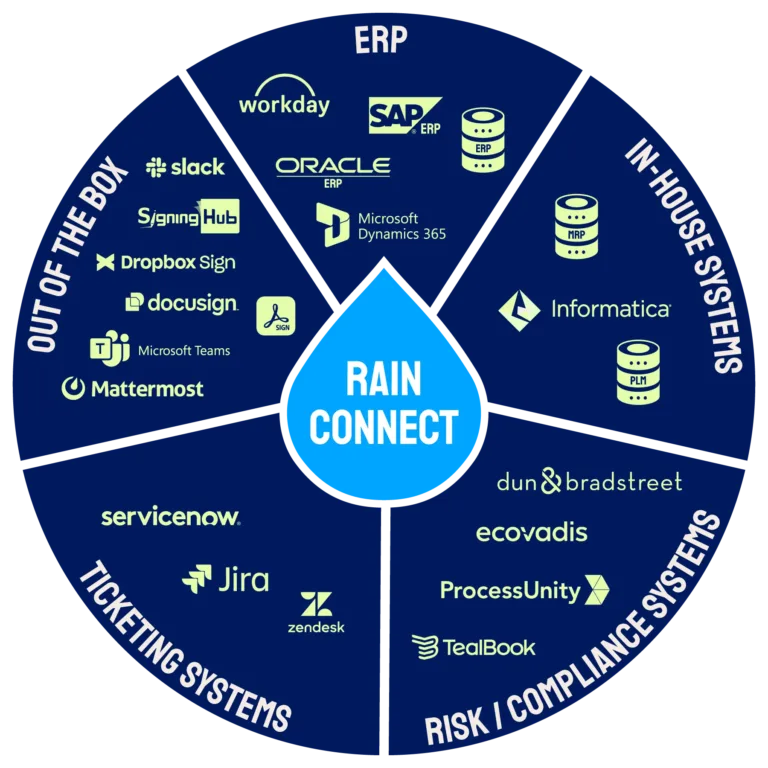
Raindrop Systems connects to your ERP through RainConnect, its built-in integration layer. For NetSuite, RainConnect provides bidirectional sync for purchase orders, receipts, invoices and vendor records. On deployment, a single module can go live in as little as one week, and the full source-to-pay suite typically takes 2 to 3 months (8 to 16 weeks). Workwear Outfitters, a Raindrop Systems customer using sourcing and contract management, runs $120M in annualized spend through the platform.
Trade-off, honestly: Raindrop Systems is a smaller company than most vendors on this list, which means a smaller public review footprint and a smaller supplier network than the incumbents. If your main job is high-volume payouts to creators, sellers or contractors, a payables-first product built around that job fits better than a full suite. If the pain is payables alone and your intake and contracts already work, a suite is more platform than you need.
How the Alternatives Compare
Every platform trades something for something else. Deployment speed is as each vendor or its implementation partner states it; several vendors do not publish a specific figure at all, which is itself useful information for a shortlist.
| Platform | Best for | Deployment speed | Notable trade-off |
|---|---|---|---|
| Tipalti | Global payables and payouts, multi-entity, tax compliance | Average go-live four weeks (Tipalti’s figure) | Volume-based pricing; payments funded through Tipalti or its bank partner |
| BILL | Per-user AP and AR with broad accounting sync | Not publicly stated | NetSuite sync sits in the Enterprise plan; 130+ countries |
| AvidXchange | US mid-market AP with supplier payments | Not publicly stated | Payments focus is domestic |
| Stampli | ERP-centered invoice and procurement workflow | Weeks (Stampli’s claim) | International payments depend on configuration |
| Coupa | Large enterprises wanting payables inside a spend suite | 12 to 16 weeks mid-market, 16 to 24 enterprise (partner figure) | Enterprise-scale cost and scope |
| Ramp | Cards, expense and bill pay in one platform | Not publicly stated | Confirm local-rail coverage for your payee countries |
| Airbase (Paylocity) | Teams already on Paylocity HR and payroll | Not publicly stated | Value ties to Paylocity’s employee record |
| Raindrop Systems | Mid-market to upper-enterprise teams wanting AP connected to intake and contracts | Single module in as little as 1 week; full suite 2 to 3 months | Smaller company than most vendors here |
Tipalti
Best for: Global payables and payouts, multi-entity, tax compliance
Deployment speed: Average go-live four weeks (Tipalti’s figure)
Notable trade-off: Volume-based pricing; payments funded through Tipalti or its bank partner
BILL
Best for: Per-user AP and AR with broad accounting sync
Deployment speed: Not publicly stated
Notable trade-off: NetSuite sync sits in the Enterprise plan; 130+ countries
AvidXchange
Best for: US mid-market AP with supplier payments
Deployment speed: Not publicly stated
Notable trade-off: Payments focus is domestic
Stampli
Best for: ERP-centered invoice and procurement workflow
Deployment speed: Weeks (Stampli’s claim)
Notable trade-off: International payments depend on configuration
Coupa
Best for: Large enterprises wanting payables inside a spend suite
Deployment speed: 12 to 16 weeks mid-market, 16 to 24 enterprise (partner figure)
Notable trade-off: Enterprise-scale cost and scope
Ramp
Best for: Cards, expense and bill pay in one platform
Deployment speed: Not publicly stated
Notable trade-off: Confirm local-rail coverage for your payee countries
Airbase (Paylocity)
Best for: Teams already on Paylocity HR and payroll
Deployment speed: Not publicly stated
Notable trade-off: Value ties to Paylocity’s employee record
Raindrop Systems
Best for: Mid-market to upper-enterprise teams wanting AP connected to intake and contracts
Deployment speed: Single module in as little as 1 week; full suite 2 to 3 months
Notable trade-off: Smaller company than most vendors here
Every "not publicly stated" cell above means exactly that: we found no specific deployment timeframe on the vendor’s own site as of October 2026. Treat those as questions to ask directly in a demo.
Tipalti vs Bill.com, and the Third Option
If your shortlist has narrowed to Tipalti or Bill.com, the deciding factors are usually seats, payee geography and ERP. BILL prices per user, from $49 to $89 per user per month on its published plans, and its Enterprise plan carries the two-way NetSuite, Sage Intacct and Microsoft Dynamics sync. Tipalti’s published plans start at $99 a month for Accounts Payable with unlimited users, plus per-transaction fees. On reach, BILL lists international payments in more than 130 countries, and Tipalti lists 200+ countries and territories in 120 currencies. A team with a handful of approvers and mostly domestic suppliers can do well on BILL. A team with many approvers, many entities, or payees spread across dozens of countries is the profile Tipalti’s payee reach is built for.
The third option
Worth putting on the table before you commit to either: is payables really where the problem starts? Both are payables-first products. Tipalti sells Procurement as an add-on module, and BILL’s Corporate plan adds purchase requests and purchase orders. If invoices stall because purchase requests skip intake, or because contracts and POs live in separate systems from AP, that is the question that sends some mid-market and upper-enterprise buyers toward a Source-to-Pay suite like Raindrop Systems, where intake, contracts, purchasing and AP share one record.
Decision Framework: What to Ask, By Role

CFO or controller
Ask for three-year total cost at your real invoice and payment volumes, with per-transaction fees, FX costs and implementation services broken out as separate lines. Ask how pricing changes when you add entities, approvers or modules, and whether payments leave from your own bank accounts or from an account funded with the vendor or its banking partner.

Procurement lead
Ask to watch a purchase request become a paid invoice, live. Ask where intake, PO creation and contract terms sit, and whether the invoice matches against them automatically. Ask what happens to supplier onboarding and tax-form collection during the transition.

IT and security
Ask for the specific ERP integration pattern (native connector, API, file-based, middleware) and who owns it once live: the vendor, a partner, or your team. Ask about SSO, audit logs and security attestations such as SOC 2 Type II, and where funds and data sit during a payment run.

Legal or compliance
Ask which tax forms and jurisdictions are covered (W-9, W-8, VAT, 1099 and 1042-S reporting), how sanctions screening works on payees, and which licenses the vendor holds to move money. Ask what the audit trail records for approvals and payment changes.
When Tipalti Is Still the Right Choice
Tipalti is the right platform for a specific buyer: a company that pays many suppliers or payees across borders (creators, artists, sellers, or a multi-entity supplier base) and wants supplier self-service onboarding, tax-form collection and compliance checks built into the payment flow. It publishes a four-week average go-live, entry pricing from $99 a month for AP, and ERP integrations for NetSuite, Sage Intacct, QuickBooks, Microsoft Dynamics and SAP, and it is listed as a Leader in the 2024 IDC MarketScape for worldwide AP automation software for the midmarket. If that describes your organization, the trade-offs in this guide are ones you’ve likely already priced in. The teams this guide helps most are the ones for whom late or messy payables is a symptom, and the cause sits earlier in the process.
Frequently Asked Questions
Tipalti is a finance automation platform, founded in 2010 and based in Foster City, California. It covers accounts payable automation, mass payments, procurement, expenses and treasury. Tipalti says it pays suppliers and payees in 200+ countries and territories, 120 currencies and 50+ payment methods, with tax-form collection, multi-entity AP and ERP integrations for NetSuite, Sage Intacct, QuickBooks, Microsoft Dynamics and SAP. Plans start at $99 a month for Accounts Payable and $249 a month for Mass Payments, plus per-transaction fees.
It depends on your priority. BILL fits teams that want per-user pricing and broad accounting sync. AvidXchange fits US mid-market companies with mostly domestic suppliers. Stampli fits teams that want workflow on top of their ERP. Ramp fits teams that want AP inside a card and expense platform. Coupa fits large enterprises that want payables inside a spend suite. Raindrop Systems fits teams whose AP trouble starts in intake, contracts or purchasing.
In nine Tipalti-alternatives roundups we reviewed in October 2026, BILL and Stampli appeared most often, followed by AvidXchange, Ramp and Airbase. Coupa, Basware and Medius also appeared in several. The roundups are mostly written by competing vendors, so treat the ranking as a sign of who gets compared, and read each vendor's own pricing and integration pages for specifics.
Neither is better for everyone. BILL prices per user, from $49 to $89 per user per month on its published plans, and its Enterprise plan carries the NetSuite, Sage Intacct and Microsoft Dynamics sync. Tipalti's published plans include unlimited users, and it lists payments in 200+ countries and territories against BILL's 130+. Your approver count, where your payees are, and which ERP you run usually decide it.
Tipalti publishes entry prices: Accounts Payable from $99 a month and Mass Payments from $249 a month, both with unlimited users. Per-transaction pricing is charged on top, and complex environments may need professional services. Because the total depends on volume, ask for a quote built on your own invoice and payment counts.
Tipalti's FAQ says technical implementation takes days, while company due diligence and account setup can take several weeks, plus time to customize supplier-facing portals, emails, workflows and signatory rights. Tipalti cites an average go-live of four weeks. For scope comparison, a single Raindrop Systems module can go live in as little as one week and a full source-to-pay suite typically takes 2 to 3 months, though those cover different scopes.
BILL (Enterprise plan), Stampli, Ramp (Plus plan), AvidXchange and Raindrop Systems all list NetSuite integrations. Raindrop Systems provides bidirectional sync for purchase orders, receipts, invoices and vendor records through RainConnect. Depth varies, so confirm the exact integration pattern and which objects sync during evaluation.
For some teams. Raindrop Systems covers AP automation, e-invoicing and RainPay inside a full source-to-pay suite. If your core need is paying large payee networks across many countries, compare payment coverage and tax handling line by line in a demo, because Tipalti is built around that job. If your AP trouble starts in intake, contracts or purchasing, a connected suite is worth the evaluation.
Get a straight answer on fit
If you’re evaluating Tipalti alternatives and want a straight answer on whether Raindrop Systems fits your scope, timeline and ERP, talk to a specialist. You’ll get a real answer about fit, including when Tipalti or another payables-first tool is the better choice.
Keep reading
- ◆NetSuite AP Automation: how bidirectional NetSuite sync works if NetSuite is your system of record.
- ◆AP Automation: the full capability set for invoice capture, matching and payment.
- ◆Coupa Alternatives: the companion guide for teams weighing enterprise spend suites.