
Section 7 – The Architecture Required To Enable Agentic AI

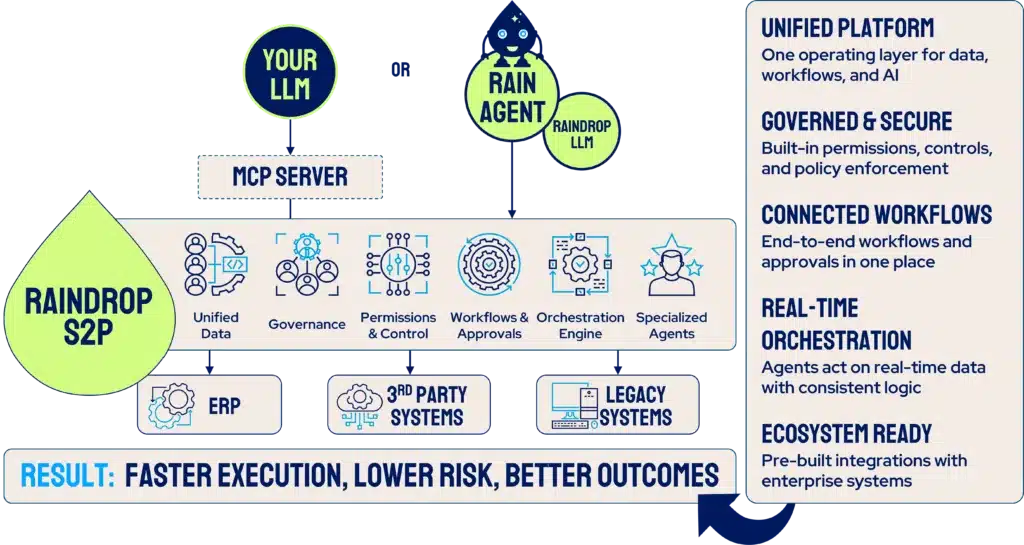
Agentic AI can be a real support for a business, but the way it’s implemented into workflows matters. Agentic AI isn’t just a simple layer of intelligence; it needs to be built on a strong foundation so it can support your team by executing meaningful work rather than being limited to generating insights.
To be successful in this scope, agentic AI needs to be able to:
- Unify procurement data: Agents must access contracts, suppliers, and financial data. Since procurement data is often spread out across multiple systems, agents need to operate on a unified data model that connects all sources, such as financial systems, sourcing platforms, contracts, and supplier records.
- Orchestrate workflows: Agents must trigger and manage workflows across systems. Since procurement typically involves multi-step processes with multiple stakeholders, coordination is necessary. A good orchestration layer will lay the groundwork for sequencing tasks, managing dependencies, enforcing business rules, and ensuring all processes are completed efficiently.
- Integrate into systems: Agents must interact with enterprise resource planning (ERP), procure-to-pay platforms (P2P), and contract lifecycle management (CLM) tools APIs allow for this integration, so agents get access to real-time data to update records, trigger necessary workflows, and execute transactions.
- Interact with security and governance action layers: Agents must operate with permissions and governance. To ensure that security and governance requirements are met, you have to build a strong framework. The framework may include role-based access controls, audit trails, monitoring and oversight by human agents, and policy enforcement mechanisms.