
Best Coupa Alternatives in 2026: 7 Procurement Platforms Compared
Buyer’s guide · Updated 2026
If you’re evaluating Coupa alternatives, the short list worth your time is SAP Ariba (closest enterprise-scale peer), GEP SMART and Ivalua (deep sourcing and contract capability), JAGGAER (public sector and complex sourcing), Zip (fast intake and orchestration layered on your existing systems), and Raindrop Systems (full source-to-pay suite built to go live in weeks). Which one fits depends on whether your problem is cost, deployment time, or a system that never got fully adopted.
Coupa remains a capable platform. But a lot of procurement teams start looking elsewhere for reasons that have nothing to do with feature gaps: implementation timelines that stretch past a year, a pricing structure that keeps growing with every module and consulting hour, and a rollout that needs a dedicated project team to finish.
This guide compares seven real alternatives, tells you what each one is actually good at, and names the honest trade-off for each. We build one of them, Raindrop Systems, so you’ll see that entry too. It gets the same treatment as the rest: what it’s good at, and where it isn’t the right fit.

Key Takeaways
- ◆The right Coupa alternative depends on what’s actually broken. If it’s implementation time and cost, look at Raindrop Systems, Zip, or GEP SMART. If it’s supplier network depth you need to keep, SAP Ariba is the closest like-for-like swap. If it’s contract-heavy sourcing at true enterprise scale, Ivalua and JAGGAER stay in the conversation.
- ◆Coupa still fits a specific buyer: large global enterprises that need its supplier network breadth and can absorb an 8 to 12 month rollout with a consulting partner. It remains the right platform for that buyer.
- ◆No platform here does everything Coupa does at Coupa’s scale for free. Every alternative trades something (network size, contract depth, or price) for something else (speed, cost, or simplicity). This guide names the trade-off for each one.
Why Buyers Look Past Coupa
Coupa built its position over more than a decade as a broad business spend management platform, and it still has real strengths: a large supplier and spend-benchmarking network, wide regional coverage, and a genuine push into agentic AI through its 2026 acquisitions of Tonkean (intake and orchestration) and Rossum (intelligent document processing). Neither of those came free, and neither shortens the path to go-live.
Three things come up most often when procurement and finance teams start evaluating alternatives.
8 to 12 months
Implementation length
Enterprise Coupa rollouts are commonly cited at 8 to 12 months. Even a specialized Coupa implementation partner quotes 16 to 24 weeks for enterprise and 12 to 16 weeks for mid-market when scope is contained, and multi-region or multi-entity programs run longer. That is the reality of a suite built for the largest, most complex organizations, where broad scope, supplier onboarding, and cross-team change management stretch every phase.
$50K to $2M+ a year
Cost that keeps climbing
Coupa prices on a negotiated, enterprise-license-plus-services model, usually bundled into a multi-year contract. Vendr’s published benchmarks put annual subscriptions at roughly $50,000 to $150,000 for basic mid-market configurations, $200,000 to $800,000 for organizations running three or more modules, and $800,000 to $2,000,000 or more for multi-region enterprise suites, with implementation adding 50% to 150% of the first-year subscription on complex deployments. That is a real number for a mid-market team to absorb before the platform delivers a single automated invoice.
Built for the largest
A platform sized for a company you might not be
Coupa’s own go-to-market centers on large, complex, multi-entity enterprises. If your procurement org has a few dozen requesters and three ERPs to reconcile, that scope can work against you: you pay for capability you won’t use for years, if ever.
Coupa is still the right call for organizations that need the network depth and can staff a long rollout. The rest of this guide is for teams asking whether there’s a better fit. See how Raindrop compares to Coupa head to head.
The Alternatives, Vendor by Vendor
Seven real alternatives, what each is actually good at, and the honest trade-off for each.
SAP Ariba
Best for: Organizations already deep in the SAP ecosystem, especially S/4HANA shops that want procurement tightly coupled to their ERP.
SAP Ariba is the closest true peer to Coupa on scale: a large supplier network, broad module coverage, and enterprise-grade licensing to match. SAP has spent 2026 rebuilding the platform on SAP Business Technology Platform, embedding Joule AI into procurement workflows and moving to real-time, event-driven integration with S/4HANA, rolled out in waves through 2026 and into 2027.
Trade-off: Ariba’s strength is also its constraint. It’s built to reward organizations that standardize around SAP; the more your stack sits outside SAP, the more custom integration work you’re signing up for. Deployment is typically a multi-quarter program, similar in scope to Coupa’s, and pricing follows the same enterprise-license-plus-services pattern.
GEP SMART
Best for: Enterprises that want a single unified platform spanning sourcing, procurement, and supply chain, without stitching together point solutions.
GEP positions SMART as an end-to-end, AI-powered platform covering the full source-to-pay lifecycle plus supply chain functions Coupa and most of this list don’t touch directly. It is a genuine full-suite competitor.
Trade-off: Breadth comes with the same weight problem as Coupa. GEP SMART is priced and deployed for large enterprise programs, and its pricing is quote-based with no published tiers, so you won’t get a cost signal until you’re deep in a sales process. Buyer reviews on independent platforms also point to a steeper learning curve and less flexible native reporting than a more streamlined tool.
Ivalua
Best for: Large enterprises with complex, highly configurable sourcing and supplier management needs, particularly regulated industries that need deep contract and compliance workflows.
Ivalua’s differentiator is configurability. It’s built to be shaped extensively to an organization’s specific sourcing and supplier governance requirements rather than adopted as a fixed workflow.
Trade-off: Configurability cuts both ways. The same flexibility that lets Ivalua match a complex sourcing process also means implementation and ongoing administration typically require more specialized configuration expertise than a more opinionated, pre-built platform.
JAGGAER
Best for: Public sector, higher education, and healthcare organizations, plus enterprises with complex, multi-stage sourcing events.
JAGGAER has a long track record in procurement categories that need rigorous, auditable sourcing processes: public sector procurement rules, complex RFx events, and supplier qualification workflows with compliance requirements Coupa’s more general-purpose sourcing tools don’t specialize in.
Trade-off: That specialization is a strength for the buyers who need it and overkill for buyers who don’t. If your sourcing process is straightforward vendor comparison rather than formal, multi-round competitive bidding with compliance documentation, JAGGAER’s depth in that specific area won’t translate into faster time-to-value elsewhere in the platform.
Zip
Best for: Teams that want to fix intake and approval chaos fast without replacing the ERP and procure-to-pay systems already in place.
Zip built its position as an orchestration and agent layer that sits across a customer’s existing ERP and procure-to-pay stack rather than replacing it. Individual products can deploy in weeks, a real speed advantage over a suite rollout.
Trade-off: Because Zip orchestrates rather than replaces, you’re still running (and paying for) the underlying ERP and procure-to-pay systems it sits on top of. If those underlying systems are the source of the friction, not just the intake experience layered on top of them, Zip solves a real problem without solving that one.
Zycus
Best for: Mid-market to enterprise procurement teams that want AI-driven sourcing and contract management with a source-to-pay footprint, at a different price point than the largest suite vendors.
Zycus has built out AI capability across its source-to-pay suite and positions itself as a full-suite alternative for organizations that want the breadth of a Coupa or SAP Ariba without the largest-enterprise price tag and rollout timeline.
Trade-off: Zycus competes on being a capable full suite at a more accessible tier, a real advantage for mid-market buyers. It’s a smaller vendor than Coupa or SAP Ariba, so the network effects that come with the largest platforms are proportionally smaller too.
We build this one
Raindrop Systems
Best for: Mid-market and upper-enterprise procurement teams that want a full source-to-pay suite, built AI-native from day one, without the multi-quarter rollout the largest platforms require.
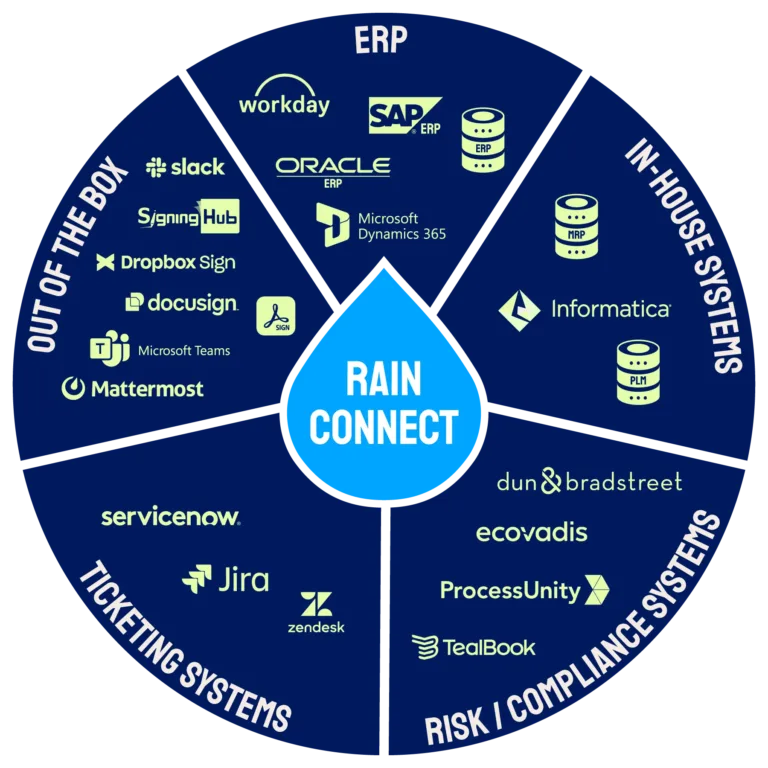
Raindrop Systems is a full source-to-pay platform: intake and orchestration, sourcing, contract lifecycle management, supplier management, AP automation, e-invoicing, and payments, in one system rather than modules stitched together after the fact. The AI layer, Rain, is built into the platform’s foundation rather than bolted on through acquisition. It connects to your existing ERP stack through RainConnect, its built-in integration layer, rather than a separate procurement software integrations project.
On deployment: a single module can go live in as little as one week, and a full source-to-pay implementation typically runs 2 to 3 months (8 to 16 weeks), which Raindrop Systems positions as the fastest time to value in the category. Raindrop Systems is a Sample Vendor in the 2026 Gartner Hype Cycle for Procurement and Sourcing Solutions, its fifth consecutive year of inclusion, and holds a 4.5 out of 5 rating across 22 ratings on Gartner Peer Insights.
Trade-off, honestly: Raindrop Systems is a smaller company than Coupa, SAP Ariba, or GEP. That means a smaller public review footprint on the largest third-party sites and a smaller supplier network than the incumbents built over a decade or more. What Raindrop Systems trades for that scale is speed to value and an AI architecture built in from the start.
How the Alternatives Compare
Every platform trades something for something else. Deployment speed is as each vendor publicly states it; several vendors do not publish a specific figure at all, which is itself useful information for a shortlist.
| Platform | Best for | Deployment speed | Notable trade-off |
|---|---|---|---|
| Coupa | Large global enterprises needing network scale | 8 to 12 months (enterprise) | Long rollout, cost grows with scope |
| SAP Ariba | SAP/S4HANA-standardized organizations | Multi-quarter program | Best value locked to SAP-centric stacks |
| GEP SMART | One platform across sourcing to supply chain | Not publicly stated | Quote-based pricing, no public signal |
| Ivalua | Complex, highly configurable sourcing needs | Not publicly stated | Configurability requires specialized setup |
| JAGGAER | Public sector, higher ed, healthcare, complex RFx | Not publicly stated | Sourcing depth built for compliance-heavy buyers |
| Zip | Fast intake/approval fix on existing systems | Individual products: weeks | Underlying systems remain in place and in cost |
| Zycus | Mid-market to enterprise wanting full suite | Not publicly stated | Smaller network scale than largest incumbents |
| Raindrop Systems | Mid-market to upper-enterprise, fast AI-native suite | Single module 1 week; full suite 2 to 3 months | Smaller company than the largest incumbents |
Coupa
Best for: Large global enterprises needing network scale
Deployment speed: 8 to 12 months (enterprise)
Notable trade-off: Long rollout, cost grows with scope
SAP Ariba
Best for: SAP/S4HANA-standardized organizations
Deployment speed: Multi-quarter program
Notable trade-off: Best value locked to SAP-centric stacks
GEP SMART
Best for: One platform across sourcing to supply chain
Deployment speed: Not publicly stated
Notable trade-off: Quote-based pricing, no public signal
Ivalua
Best for: Complex, highly configurable sourcing needs
Deployment speed: Not publicly stated
Notable trade-off: Configurability requires specialized setup
JAGGAER
Best for: Public sector, higher ed, healthcare, complex RFx
Deployment speed: Not publicly stated
Notable trade-off: Sourcing depth built for compliance-heavy buyers
Zip
Best for: Fast intake/approval fix on existing systems
Deployment speed: Individual products: weeks
Notable trade-off: Underlying systems remain in place and in cost
Zycus
Best for: Mid-market to enterprise wanting full suite
Deployment speed: Not publicly stated
Notable trade-off: Smaller network scale than largest incumbents
Raindrop Systems
Best for: Mid-market to upper-enterprise, fast AI-native suite
Deployment speed: Single module 1 week; full suite 2 to 3 months
Notable trade-off: Smaller company than the largest incumbents
Every "not publicly stated" cell above means exactly that: the vendor hasn’t published a specific deployment timeframe on its own site. Treat those as questions to ask directly in a demo.
Coupa vs SAP Ariba, and the Third Option
If your shortlist has narrowed to Coupa or SAP Ariba, the deciding factor is rarely features. Both are full business spend management suites with broad module coverage, enterprise pricing, and multi-quarter to multi-month rollouts. The real question is which ecosystem you’re already standardized on. If your finance and ERP stack is SAP, especially S/4HANA, SAP Ariba’s tighter native integration is a genuine advantage that Coupa can’t fully replicate without more integration work on your side. If you’re not an SAP shop, that advantage disappears and the comparison comes down to Coupa’s larger public supplier network against SAP Ariba’s ecosystem depth.
The third option
Worth putting on the table before you commit to either: do you actually need a suite built for the largest enterprises in the world, or do you need full source-to-pay coverage at a rollout timeline and cost that matches your team’s actual size? That’s the question that sends a lot of mid-market and upper-enterprise buyers toward Zycus, Raindrop Systems, or a fast orchestration layer like Zip instead of the two largest incumbents.
Decision Framework: What to Ask, By Role

CFO or controller
Ask for total cost of ownership over three years, with implementation cost broken out as its own line. Ask how pricing scales as you add modules or users, and whether that’s predictable or a fresh negotiation every time.

Procurement lead
Ask to see the actual intake and approval workflow live rather than on a slide. Ask how long a single module takes to configure for a team your size, with a reference customer at similar scale. Ask what happens to supplier onboarding during the transition.

IT and security
Ask for the specific integration pattern with your ERP (native API, iPaaS middleware, custom build) and who owns it once live: the vendor, a systems integrator, or your team. Ask how the platform handles SSO, data residency, and API rate limits at your transaction volume.

Legal or compliance
Ask how contract data moves during migration, what audit trail exists for AI-assisted approvals or sourcing recommendations, and whether the vendor’s data processing terms match your regulatory obligations, especially across multiple jurisdictions.
When Coupa Is Still the Right Choice
Coupa is the right platform for a specific buyer: a large, complex, often multi-entity or multi-region enterprise that needs Coupa’s supplier network scale and community spend-benchmarking data, has the budget to absorb an 8 to 12 month implementation with a consulting partner, and values a platform with more than a decade of enterprise deployment history behind it. If that’s your organization, the trade-offs in this guide are ones you’ve likely already priced in. The teams for whom this guide is most useful are the ones for whom that timeline and cost structure don’t fit the size of the problem they’re trying to solve.
Frequently Asked Questions
There isn't a single best alternative; it depends on your priority. SAP Ariba is the closest match if you're standardized on SAP. GEP SMART and Ivalua fit organizations that need deep sourcing and contract configurability at enterprise scale. Zip fixes intake and approval friction without replacing your existing systems. Raindrop Systems fits mid-market and upper-enterprise teams that want a full source-to-pay suite without Coupa's multi-quarter rollout.
The three most common reasons: implementation length (enterprise rollouts commonly run 8 to 12 months), cost that grows with scope and consulting hours, and a platform sized for the largest enterprises when the buyer's own procurement org is smaller. These are fit and timeline problems rather than feature gaps.
Zycus and Raindrop Systems position themselves at a different price tier than Coupa or SAP Ariba. Every vendor in this guide uses quote-based pricing rather than a published rate card, so "cheaper" depends on your specific scope. Ask each vendor for total cost of ownership over three years before comparing.
It depends on which platform you're moving to and how much of your current configuration, supplier data, and integrations need to migrate. A single module on a fast-to-deploy platform can go live in as little as a week; a full source-to-pay replacement is a multi-month project regardless of vendor. Ask any vendor for a migration timeline based on your actual Coupa footprint rather than a generic estimate.
Neither is universally better. SAP Ariba has a real integration advantage if you're standardized on SAP or S/4HANA. Coupa has a larger public supplier network and community spend-benchmarking data. Both are full enterprise suites with multi-quarter to multi-month implementations and enterprise-level pricing. Your existing ERP ecosystem is the deciding factor more than any other.
Most vendors on this list, Raindrop Systems included, publish native integrations with the major ERPs (SAP, Oracle, NetSuite, Microsoft Dynamics 365, Workday). Depth varies by vendor and by which ERP module you're connecting to, so confirm the exact integration pattern (native API versus middleware) during evaluation rather than assuming parity across vendors.
You Might Also Find This Useful
- ◆Raindrop Systems vs Coupa: a full head-to-head comparison if Coupa is still on your shortlist.
- ◆Raindrop Systems vs SAP Ariba: for teams weighing Raindrop against SAP’s ecosystem-native option.
- ◆Fast to Deploy Procurement Systems: A Complete Guide: what actually drives implementation speed, beyond marketing claims.
- ◆AP Automation and Procurement for NetSuite: how a full source-to-pay suite connects to NetSuite, and when a point tool is enough.
- ◆Procurement Software Integrations: The Complete Guide: what to check before you trust any vendor’s ERP integration claims.
Get a straight answer on fit
If you’re evaluating Coupa alternatives and want a straight answer on whether Raindrop Systems fits your scope, timeline, and budget, talk to a specialist. You’ll get a real answer about fit, including when Raindrop Systems is the wrong fit.