What Is Supplier Management? The Complete Guide for Procurement Teams
Key Takeaways
- Supplier management is the end-to-end process of onboarding, qualifying, monitoring, collaborating with, and optimizing your supplier base—covering everything from initial registration to ongoing performance tracking and risk mitigation.
- Traditional supplier management breaks down when data lives across ERPs, spreadsheets, shared drives, and email threads—creating compliance gaps, slow onboarding, and decisions made on incomplete information.
- Modern supplier management platforms unify supplier data into a single system, automate onboarding, monitor risk in real time, and give vendors self-service access—with organizations reporting up to 75% onboarding automation and 80% efficiency gains.
You’ve got 500 suppliers. Maybe 2,000. The contract terms for half of them live in one system, performance data in another, and the compliance documentation? Scattered across someone’s email, a shared drive, and a spreadsheet that hasn’t been updated since last quarter.
This isn’t unusual. It’s the norm. Most procurement teams manage suppliers across five or more disconnected systems—and the result is the same everywhere: slow onboarding, missed renewals, compliance blind spots, and strategic decisions made on incomplete data. It’s why supplier risk management has become a board-level concern.
Supplier management is supposed to fix this. But the term gets thrown around loosely, and it means different things depending on who you ask. Is it the same as vendor management? How does it relate to SRM? What separates a basic supplier database from an actual supplier management platform?
This guide cuts through the confusion. We’ll cover what supplier management actually is, why traditional approaches break down, what modern supplier management looks like, and how to evaluate solutions—whether you’re building a business case or comparing platforms.
What Is Supplier Management?
Definition
Supplier management is the structured process of managing your organization’s relationships with external suppliers across the entire lifecycle—from initial identification and onboarding through ongoing performance monitoring, risk management, and strategic optimization.
It’s broader than just keeping a list of vendors. True supplier management connects the dots between who your suppliers are, what they’ve committed to, how they’re performing, and what risks they carry. When it’s done well, procurement, legal, and finance all work from the same data. When it’s not, you’re stitching together a picture from five different puzzles.
The Five Core Functions
1. Onboard
Bring new suppliers into the system efficiently—collecting tax forms, compliance documents, insurance certificates, bank details, and contact information through a structured process instead of weeks of email back-and-forth.
2. Qualify
Verify that suppliers meet your organization’s requirements: financial stability, regulatory compliance, insurance coverage, ESG criteria, diversity certifications. This happens before they’re approved to do business—and needs to be rechecked periodically.
3. Monitor
Track supplier performance, risk, and compliance on an ongoing basis. This includes financial health monitoring, contract obligation tracking, certification expiration alerts, and industry risk factors that could impact your supply chain.
4. Collaborate
Manage day-to-day interactions with suppliers: contract negotiations, issue resolution, document sharing, and status updates. The best supplier relationships are built on clear communication—not email chains that nobody can find six months later.
5. Optimize
Use data to make better decisions about your supplier base. Which suppliers deliver the most value? Where are you overpaying? Which relationships should be expanded, renegotiated, or sunsetted? Optimization turns supplier management from a cost center into a strategic advantage.
Why Traditional Supplier Management Is Broken
Most organizations aren’t short on supplier data. They’re short on supplier visibility. Here’s where it goes wrong.
Fragmented Data, No Single Source of Truth
Supplier information lives in ERPs, procure-to-pay tools, shared drives, email threads, and spreadsheets. Contract terms sit in one system, performance data in another, invoices in AP. When you need a complete picture of a supplier relationship, you’re assembling pieces from multiple systems—and hoping nothing’s outdated.
According to Ardent Partners, best-in-class organizations achieve 91% spend under management while the average sits at just 66%. That 25-point gap is full of risk, waste, and missed opportunities that better supplier visibility would catch.
Onboarding That Takes Weeks
Bringing on a new supplier shouldn’t require two weeks of email volleyball—but it often does. Tax forms, compliance docs, insurance certificates, bank verification, internal approvals. Each step is manual, each handoff creates delay, and the business unit that needed this supplier two weeks ago is still waiting.
Compliance That’s Reactive, Not Preventive
Contracts auto-renew because nobody tracked the expiration date. Certifications lapse because the spreadsheet wasn’t updated. Regulatory requirements that should trigger supplier reviews get tracked manually—when they get tracked at all. By the time procurement discovers a gap, the exposure is already real.
Communication Without a Record
Supplier conversations happen across email, Slack, Teams, phone calls, and meetings. None of it is centralized. None of it is auditable. And when someone leaves the team, their institutional knowledge of that supplier relationship walks out the door.
Processes That Don’t Scale
Procurement and finance teams manually review invoices, route approvals via email, track performance in spreadsheets, and read every contract clause. It works for 50 suppliers. It doesn’t work for 500. And it’s exactly the kind of work that creates errors, delays, and burnout.
What Modern Supplier Management Looks Like
The shift from traditional to modern supplier management isn’t just about better software. It’s about fundamentally changing how supplier data flows through your organization.
Unified Data Model
Every supplier detail—profiles, contracts, invoices, payments, risk scores, compliance docs—lives in one system. When procurement updates a supplier profile, legal and finance see it immediately. No duplicate data. No reconciliation. No “which version is current?”
This is the single biggest differentiator between modern platforms and traditional approaches. A unified data model means you can answer “who buys what from whom, for how much, under what terms, with what risk?” in real time—not after a week of spreadsheet reconciliation.
AI-Powered Onboarding
Instead of email chains and manual document chasing, modern platforms use AI to guide requesters through supplier onboarding. This is the concept behind the digital front door for procurement—a single intake point that replaces scattered requests with structured, automated workflows. The system asks the right questions, collects the right documents, routes approvals automatically, and adapts the workflow based on supplier type and risk level.
Organizations using AI-powered onboarding report automation improvements of up to 75%—meaning three-quarters of the manual work is eliminated.
Supplier Self-Service
Why should your team chase vendors for updated insurance certificates or W-9 forms? Modern platforms give suppliers their own portal to manage profiles, submit documents, update certifications, and track invoices. The administrative burden shifts from your team to the vendor—and data quality improves because suppliers are updating their own information.
Real-Time Risk Monitoring
Waiting for a quarterly review to discover supplier risk is too slow. Modern platforms monitor supplier financial health, compliance status, industry events, and certification expirations in real time. Automated alerts flag problems before they become crises—so you’re managing risk proactively, not reactively.
Embedded Collaboration
Communication about suppliers happens inside the system of record—not in email threads nobody can find later. Comments, documents, and decisions are tied to specific suppliers, contracts, and transactions. Internal and external conversations are separated. And everything is auditable.
Supplier Management vs. SRM vs. VMS: What’s the Difference?
These terms get used interchangeably, but they’re not the same thing. Here’s how they relate:
Supplier Management is the broadest category. It covers the entire lifecycle of managing suppliers: onboarding, qualification, risk monitoring, performance tracking, collaboration, and optimization. Think of it as the umbrella that includes everything related to managing your supplier base.
Supplier Relationship Management (SRM) is a subset of supplier management focused specifically on the strategic relationship. SRM is about segmenting your suppliers by importance, developing deeper partnerships with key vendors, conducting regular business reviews, and creating mutual value. Not every supplier needs SRM—your top 20% strategic suppliers do.
Vendor Management System (VMS) is typically narrower—focused on managing contingent labor and staffing agency relationships. A VMS handles temporary workers, statement-of-work engagements, and staffing supplier management. It’s a specific tool for a specific use case, not a replacement for broader supplier management.
The bottom line: Supplier management is the whole game. SRM is the strategic relationship layer. VMS is a specialized tool for contingent workforce. Most procurement teams need supplier management first, then layer on SRM practices for key relationships.
How to Evaluate Supplier Management Software
If you’re comparing platforms, here’s what separates the good from the adequate:
1. Unified Data Model vs. Fragmented Modules
The biggest question: Does the platform operate on a single data model where all supplier information is connected—or is it a collection of separate modules that pass data between each other through integrations?
A unified model means procurement, legal, and finance all see the same data in real time. Fragmented modules mean you’re still reconciling information across systems—you’ve just moved the problem from spreadsheets to software.
2. AI-Native vs. AI-Added
Some platforms were built with AI embedded from the ground up. Others added AI features to existing architectures. The difference shows up in how deeply AI is integrated:
- AI-native: Categorization, routing, risk analysis, document extraction, and recommendations all powered by AI that learns from your data. Here’s what AI-native actually means in a Source-to-Pay platform.
- AI-added: A chatbot or document scanner bolted onto existing workflows that doesn’t fundamentally change how the system works.
3. Supplier Self-Service
Does the platform give suppliers their own portal? Can vendors manage profiles, submit documents, update certifications, and track invoices without your team’s involvement? Self-service is critical for scaling—if your team has to manually process every supplier update, you’re building a bottleneck into the system.
4. Connection to the Full Lifecycle
Supplier management doesn’t exist in isolation. Evaluate how the platform connects to:
- Sourcing: Can you discover and evaluate new suppliers within the same system?
- Contracts: Does supplier data flow into contract management?
- AP/Invoicing: Are invoices linked to supplier profiles and contract terms?
- Spend analytics: Can you see spend by supplier alongside performance and risk data?
5. Speed to Value
Legacy platforms take months or years to implement. Modern solutions should deploy modules in weeks, show measurable ROI within a quarter, and require minimal IT lift. Ask about implementation timelines—and ask for customer references who can confirm them.
The Business Case: ROI and Metrics
Supplier management improvements translate directly to measurable outcomes. Real-world ROI data from AI-driven procurement backs this up:
- Up to 75% onboarding automation — eliminating manual document chasing and email-based approvals
- 80% improvement in efficiency — reducing administrative overhead through self-service and automated workflows
- Go-live in weeks, not months — modern cloud-native platforms deploy individual modules in 2–4 weeks
- Measurable risk reduction — real-time monitoring catches compliance gaps, financial instability, and certification expirations before they become problems
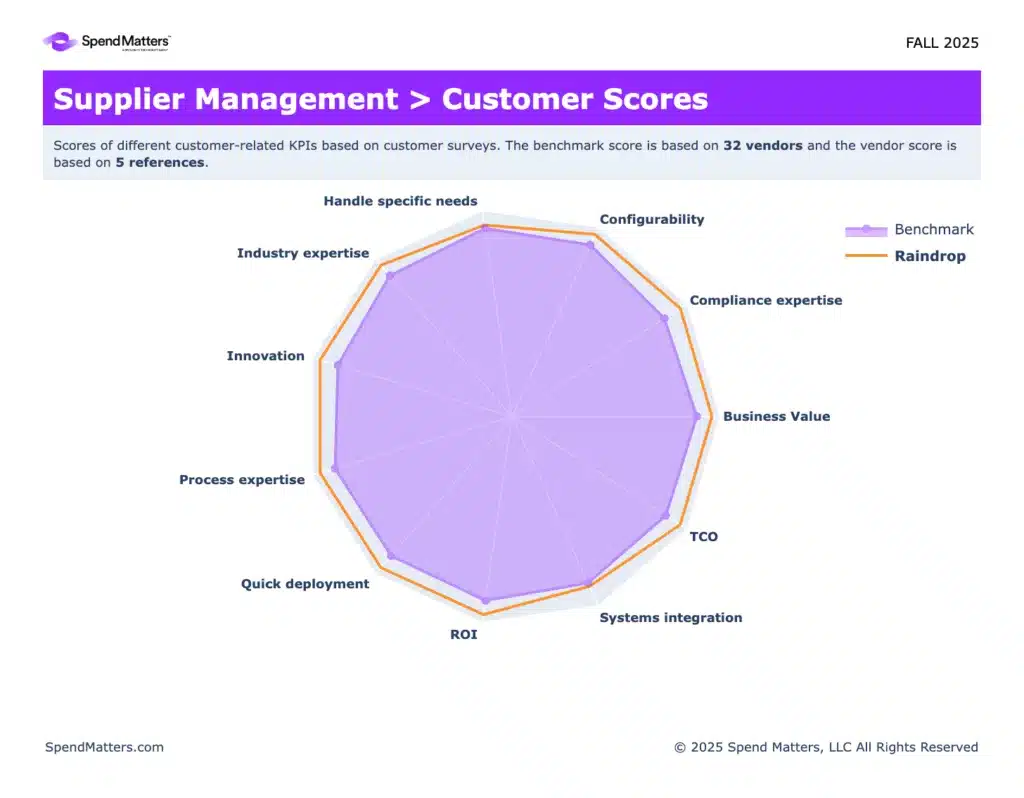
According to The Hackett Group, organizations using AI-native procurement platforms see 2.6× ROI and 58% faster cycle times. Spend Matters has recognized multiple platforms—including Raindrop Systems—as Customer Favorites for supplier management based on real user feedback.
The fastest path to ROI? Start with onboarding automation and supplier self-service. These deliver immediate, visible results—fewer emails, faster cycle times, and less administrative work—that build momentum for broader supplier management improvements.
Getting Started
If you’re evaluating supplier management solutions or building a business case, start here:
Assess Your Current State
- How many systems hold supplier data today?
- How long does onboarding take from request to approved vendor?
- Can you answer “who buys what from whom, for how much?” right now?
- When was the last time an expired contract or lapsed certification caused a problem?
Define Your Priorities
Not every organization needs everything at once. The most common starting points:
- Onboarding automation — immediate time savings, high visibility
- Unified supplier profiles — single source of truth for every team
- Risk and compliance monitoring — reduce exposure, improve audit readiness
- Supplier self-service — shift administrative burden to vendors
Evaluate Solutions
Look for platforms that offer a unified data model, AI-native capabilities, supplier self-service, and connection to the full source-to-pay lifecycle. Ask about implementation timelines and customer references.
Raindrop Systems’ Supplier Management module is built on a unified data model that connects supplier profiles to contracts, sourcing events, invoices, and payments—with AI-powered onboarding, a Supplier Marketplace for vendor self-service, and real-time risk monitoring. See how it works →
Frequently Asked Questions
What’s the difference between supplier management and procurement?
Supplier management is a function within procurement. Procurement covers the entire process of acquiring goods and services—sourcing, negotiation, contracting, purchasing, and payment. Supplier management focuses specifically on managing the relationships and data around the suppliers who provide those goods and services.
How is supplier management different from vendor management?
In practice, the terms are often used interchangeably. “Vendor management” tends to be more common in IT and contingent workforce contexts, while “supplier management” is more common in procurement and supply chain. The underlying process is the same: onboarding, qualifying, monitoring, and optimizing external providers.
Do I need a separate supplier management platform, or is my ERP enough?
ERPs handle transactional supplier data—purchase orders, invoices, payments—but typically lack the depth for supplier lifecycle management. They don’t automate onboarding, monitor risk in real time, provide supplier self-service, or connect supplier data to contracts and sourcing. Most organizations use a supplier management platform alongside their ERP, not instead of it.
How long does it take to implement supplier management software?
Modern cloud-native platforms deploy individual modules in 2–4 weeks. Full source-to-pay implementations typically take 3–4 months. Legacy on-premise solutions can take 6–12 months or longer. Ask vendors for customer references who can confirm their deployment timelines.
What’s the minimum number of suppliers that justifies a platform?
There’s no hard rule, but most organizations feel the pain when they’re managing 100+ suppliers. At that point, manual processes become unsustainable—onboarding takes too long, compliance tracking gets unreliable, and spreadsheets can’t keep up. Mid-market organizations ($250M–$2B revenue) often see the fastest ROI because they have real complexity but fewer resources for manual processes.
How do I measure supplier management success?
Key metrics include: onboarding cycle time (request to approved vendor), percentage of spend under management, supplier compliance rate, number of automated vs. manual supplier updates, risk incidents caught before impact, and time spent on administrative supplier tasks. Track these before and after implementation to quantify ROI.
Can supplier management help with ESG and sustainability goals?
Yes. Modern platforms track supplier ESG data, sustainability certifications, diversity classifications, and environmental compliance alongside traditional supplier information. This makes it possible to report on sustainable sourcing, track progress against diversity goals, and ensure suppliers meet your organization’s ESG requirements—without maintaining separate tracking systems.
Next Steps
Supplier management isn’t a project with a finish line—it’s an ongoing capability that gets more valuable as your data improves and your processes mature. The organizations that get it right move from reactive vendor management (scrambling when something breaks) to proactive supplier strategy (making better decisions before problems surface).
The good news: you don’t have to fix everything at once. Start with the highest-pain area—usually onboarding or compliance tracking—prove the value, and expand from there.
Ready to see what modern supplier management looks like in practice? Explore how Raindrop Systems approaches supplier management, or request a demo to see the platform in action.