
Section 5 – Examining Core Use Cases for Agentic AI in Procurement and Finance
How to think about Agentic in Procurement and FInance
Agentic AI can deliver value across the entire Procurement lifecycle. It embeds intelligence directly into your workflows, helping to manage decision-heavy processes and coordinate actions across systems. Agentic AI is also capable of adapting to changing conditions, making it beneficial in multiple use cases, such as those below. Let’s look at an overall example before we dig into some specific Use Cases to see how agentic AI could work for you.
Example:
A user prompts the system with this question: “What is our greatest cost savings opportunity right now?”
The system analyzes the question before moving on to look at all procurement data across multiple contracts, sourcing events, suppliers, and invoices. Then, it comes back with a set of findings.
Rain our Agentic AI:
- Identifies contracts nearing renewal with price increases
- Highlights suppliers with pricing inconsistencies
- Surfaces maverick spend outside negotiated agreements
- Recommends sourcing events or renegotiation actions
- Detects underutilized or missed savings
Then, based on this analysis, the system goes a step further. It recommends each additional step that should be taken, such as:
- Initiating sourcing events
- Renegotiating contracts with suppliers
- Consolidating suppliers to improve pricing leverage
- Creating tasks for human procurement teams
…and so on.
Importantly, it is optional for agentic AI systems to implement workflows, so you can take the time to review what the system suggests that it wants to do initially, until you’re sure that it’s taking the steps that you would agree with yourself.
So let's look at 5 Use Cases in more detail you can start with right away.
Use Case: Intake and Request management
The Problem: Procurement requests often come from multiple sources, which can include messaging tools or email, among others. This fragmentation can lead to inefficiencies, inconsistent handling, delays, and other problems. And, teams have to manually interpret the requests, determining which processes are appropriate to handle them and sourcing information before any work can begin.
Agent Role: The agentic AI steps in by interpreting incoming requests. It can classify them and then initiate the appropriate procurement workflow.
Example Workflow:
- Analyze incoming request content across channels
- Identify request type (request new supplier, financial commitment, purchase need, or new contract)
- Route to the correct process
- Gather required information through system data or follow-up prompts
- Initiate approval workflows
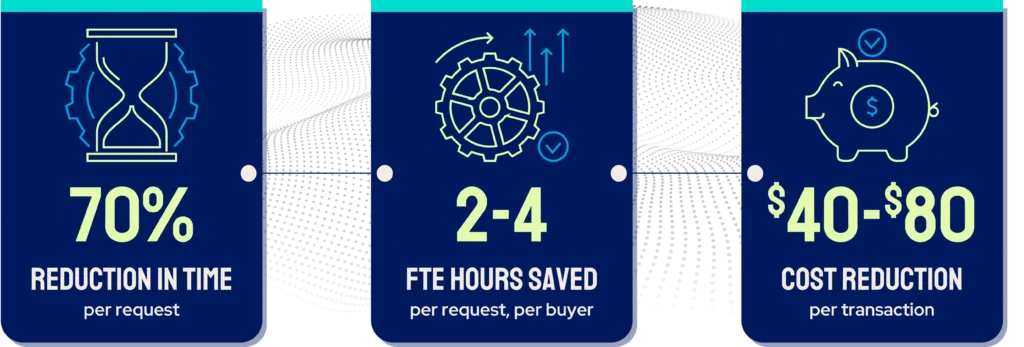
Key Benefits: Agentic agents reduce the time per request by around 70 percent, save 2 to 4 Full-Time Equivalent (FTE) hours per request (per buyer) and reduce the cost per transaction to between $40 and $80 (compared to the $100 to $200 average).
Use Case: Supplier onboarding & Management
Problem: Supplier onboarding requires coordination between multiple teams, like procurement teams, legal, finance and compliance. The process typically involves multiple handoffs, and when using manual tracking, it can lead to delays due to missing information and incomplete documentation.
Agent Role: Agents help push past delays by coordinating onboarding workflows and tracking progress while ensuring compliance requirements are met.
Example Workflow:
- Request and collect supplier documentation
- Monitor compliance requirements and the completion of those steps
- Flag supplier risk issues, such as missing information
- Track onboarding progress
In this process, agents act as centralized coordinators, ensuring every step of onboarding goes as smoothly as possible.
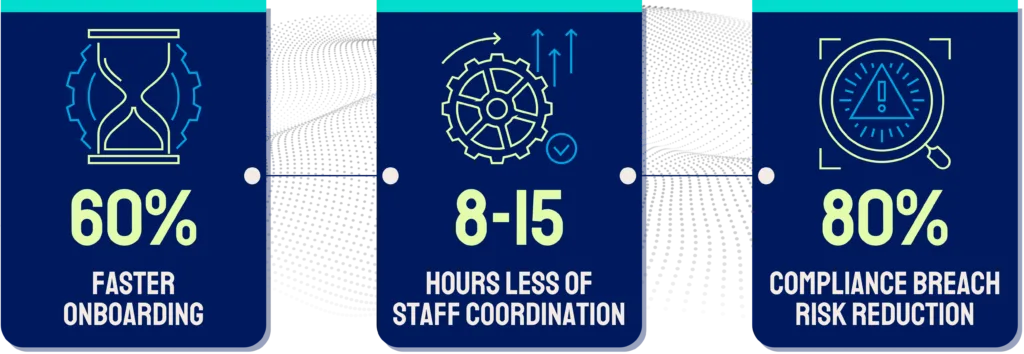
Key Benefits: Agentic agents reduce onboarding cycle time by approximately 60 percent, reduce staff coordination time to 8 to 15 hours, and reduce the risk of compliance breaches by approximately 80%.
Use Case: Contract Lifecycle Management (CLM)
Problem: After executing contracts, organizations often lose visibility into their obligations and the appropriate timelines. It’s possible to accidentally miss renewal dates or to overlook risks.
Agent Role: Agents continuously monitor contracts and manage lifecycle events, improving visibility from start to finish.
Example Workflow:
- Track renewal and expiration dates
- Analyze contract terms to be sure there are no risks or inconsistencies
- Summarize contract risks, including duplicate or conflicting contracts
- Notify teams of obligations and deadlines
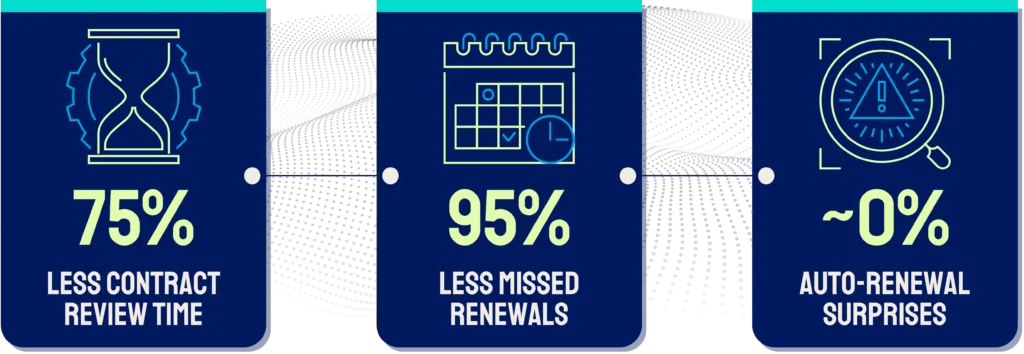
Key Benefits: Agentic AI helps reduce contract review time by 75 percent, missed renewals by around 95 percent with proactive alerts, and auto-renewal “surprises” to near zero (compared to a 15 to 20 percent industry average).
Use Case: Sourcing and Supplier Discovery
Problem: Identifying suppliers and analyzing bids requires manual research, which takes an immense amount of effort. The process is time-consuming and limits options for analyzing and evaluating options clearly or effectively.
Agent Role: Agents assist with supplier discovery, sourcing preparation, and analysis.
Example Tasks:
- Identify potential suppliers based on preset criteria
- Generate and prepare RFx documents
- Collect and summarize proposal responses
- Recommend suppliers based on overall evaluation criteria
Agents help to reduce the time needed to complete sourcing events while also improving the quality of analysis performed. For procurement teams, this means there is more time to make informed decisions and respond to growing business needs.
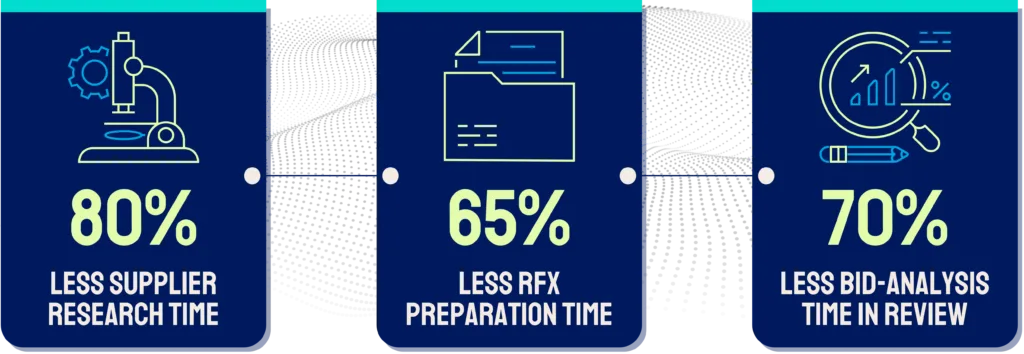
Key Benefits: Agentic AI supports faster supplier research time, reducing the time needed by approximately 80 percent. It also reduces RFX preparation time by around 65 percent and bid-analysis time by approximately 70 percent in proposal review.
Use Case: Accounts Payable & Invoice Processing
Problem: Invoice processing is repetitive and error-prone, and it’s a manual process that takes time. Teams have to not only create invoices but also validate and manage them, reconcile discrepancies, and manage approval workflows. All of this slows down the payment cycle and introduces a real risk of human error.
Agent Role: Agentic tools analyze invoices and manage exception workflows. They validate data and automatically handle repetitive verification tasks to ensure accounts payable and invoice processing run smoothly.
Example Workflow:
- Validate invoices against contracts and purchase orders
- Detect duplicate payments and inconsistent invoices
- Identify discrepancies in pricing or terms
- Trigger approval workflows based on rules set by the team
- Detect fraud or anomalies in the workflow
By automating invoice processing, it is possible to reduce the risk of human error, accelerate the speed of approvals, improve financial accuracy, and much more.
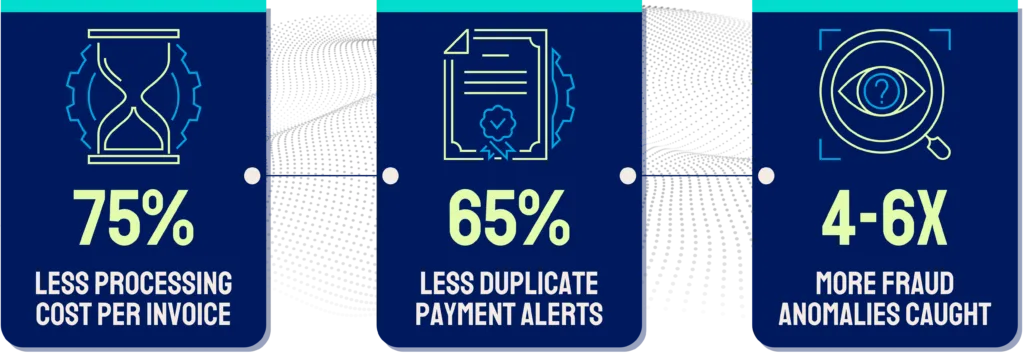
Key Benefits: Agentic AI saves you time and money, reducing invoice processing costs by around 75 percent per invoice. It also reduces duplicate payment alerts by approximately 65 percent. Finally, it supports fraud detection, catching four to six times more anomalies than traditional systems.