Zip Alternatives and Competitors in 2026: A Procurement Buyer’s Guide
Buyer’s guide · Updated 2026
If you’re searching for ZipHQ competitors or comparing Zip procurement alternatives, the short list worth your time is Coupa (a full suite that is acquiring an intake orchestration tool), ORO Labs (orchestration across the systems you already run), Omnea (intake, supplier risk and procure-to-pay), Levelpath (a newer AI-native suite), Ramp (procurement inside a finance platform for mid-market teams), Procurify (purchasing, AP and budgets for mid-market buyers), and Raindrop Systems (a full source-to-pay suite with intake built in). Which one fits depends on one question first: do you want a layer on top of your systems, or the system itself?
First, what is Zip? Here we mean the procurement platform at zip.com (formerly ziphq.com), which shares a name with an unrelated buy-now-pay-later app. Zip calls itself an AI platform for procurement that orchestrates every request from intake to pay. Founded in 2020, it raised a $190 million Series D at a $2.2 billion valuation in October 2024, and Zip says Gartner named it a Visionary in the 2026 Magic Quadrant for Source-to-Pay Suites. Its CEO describes Zip as the orchestration layer that sits on top of ERPs, which he calls systems of record.
This guide compares seven Zip alternatives, says what each one is genuinely good at, and names the honest trade-off for each. We also cover Zip vs Coupa, the comparison buyers ask about most. We build one of the seven, Raindrop Systems, so you’ll see that entry too. It gets the same treatment as the rest: what it’s good at, and where it isn’t the right fit.

Key takeaways
- ◆Start with the work you need each product to run. Zip and ORO Labs lead with orchestration across the systems you already own, though Zip also lists PO and invoice management. Omnea lists both orchestration and procure-to-pay. Coupa, Levelpath and Raindrop Systems are broader suites. Match each step of your process to a tool before you compare costs.
- ◆Zip still fits a specific buyer: a large company keeping its ERP and its purchasing stack, whose real pain is the front door, meaning requests and cross-functional approvals. For that buyer it’s a strong choice.
- ◆Price the whole stack. None of the orchestration vendors here publishes a price, and an orchestration layer still needs systems underneath it. Compare three-year cost for everything you’ll run, including what Zip sits on.
Why Buyers Look Past Zip
Zip has real strengths: a broadening product range, customers it names publicly such as OpenAI, T-Mobile and Dollar Tree, and a place in Gartner’s 2026 Magic Quadrant for Source-to-Pay Suites as a Visionary, which Zip says makes it the only procurement orchestration platform on that chart. Those are the reasons it lands on so many shortlists.
Three questions are worth testing when you evaluate alternatives.
On top
A layer over other systems
Zip’s CEO describes it as the orchestration layer on top of systems of record, and Zip’s own NetSuite guide says Zip does not replace the ERP; vendor, PO and spend data sync between the two. That’s the design, and it works when the systems underneath are healthy. If the pain sits in invoice matching or the ERP itself, check how much of that work Zip handles and how much stays underneath.
5 Superagents
A platform still adding products
Zip unveiled 50 AI agents in June 2025, and in June 2026 it introduced five Superagents (procurement, contract, AP, configuration and intake) and Zip MCP, saying the Superagents would be available that summer. It now lists contract orchestration, sourcing, risk orchestration and supplier onboarding alongside intake and procure-to-pay. That’s fast progress. Ask which modules are generally available today, and which ones customers your size run in production.
Quote only
Pricing you only see in a quote
Zip publishes no pricing, and the only implementation time we found on its site is "eight weeks or less," stated for NetSuite customers. Ask for both in writing, built on your scope, and add the cost of the systems Zip will sit on top of.
Zip is still the right call for large organizations that are keeping their ERP and purchasing tools and need one front door for requests. The rest of this guide is for teams asking whether there’s a better fit. See how Raindrop Systems compares to Zip head to head.
Zip Competitors and Alternatives, Vendor by Vendor
Seven real alternatives, what each is actually good at, and the honest trade-off for each.
Coupa
Best for: Large enterprises that want one spend platform across procurement, finance and supply chain.
Coupa says 55% of the Fortune 500 work with it, and it lists itself as a Leader in Gartner’s 2026 Magic Quadrant for Source-to-Pay Suites for the third year running. In May 2026 it announced the acquisition of Tonkean, an intake orchestration platform with more than 250 native connectors, which puts Coupa in Zip’s core category.
Trade-off: Coupa is a large suite. Acquis Consulting, a Coupa implementation partner, quotes 12 to 16 weeks for most mid-market deployments and 16 to 24 weeks for enterprise. If your only gap is intake, that’s a lot of platform to take on.
ORO Labs
Best for: Global enterprises that want orchestration across several ERPs and suites they plan to keep.
ORO Labs positions itself as agentic procurement orchestration for global enterprises, built to orchestrate existing ERPs, suites and point solutions, and it presents a partnership with SAP. It lists intake management, supplier onboarding and maintenance, and risk and compliance, plus an agent builder and a bring-your-own-model option. It shows Pfizer, Roche and Coca-Cola on its site and raised a $100 million Series C in March 2026.
Trade-off: ORO Labs is the same kind of tool as Zip: a layer, with your systems of record staying underneath. It publishes no pricing or implementation timeline, so ask for both built on your scope.
Omnea
Best for: Teams that want intake, supplier risk and purchasing in one newer platform.
Omnea calls itself the agentic operating system for procurement. It lists intake and orchestration, source-to-contract, procure-to-pay (PO automation, AP and e-invoicing) and supplier management, including third-party risk, and says it has more than 200 integrations. It names Spotify, PayPal and Adyen among its customers and raised a $50 million Series B in September 2025.
Trade-off: Omnea publishes no pricing or deployment timeline, so ask for both built on your scope. If invoice volume drives your decision, test its AP and e-invoicing workflows with your own invoices.
Levelpath
Best for: Enterprises that want a newer, AI-native suite with sourcing and contracts at its center.
Levelpath calls its platform Ranger and positions it as autonomous procurement. It lists intake and orchestration, sourcing, supplier management, contract management, risk management and procure-to-pay, and names integrations including Oracle Fusion, NetSuite, Coupa, Ironclad and Docusign. Its site shows American Airlines and Western Union, and it raised a Series B of more than $55 million in June 2025.
Trade-off: Levelpath publishes no pricing or implementation timeline. Ask to see its procure-to-pay workflow end to end with your ERP and any procurement systems you plan to keep.
Ramp
Best for: Mid-market finance teams without dedicated procurement staff.
Ramp positions its procurement product for mid-market finance teams that don’t have dedicated procurement headcount. Employees request what they need in plain language, and once approved, Ramp creates a purchase order or issues a virtual card. Ramp says AI Intake is free for its customers, and its Plus plan lists at $15 per user per month plus a platform fee, with Procurement as an add-on. Ramp says most teams are fully operational within a week. We cover Ramp’s AP side in our Tipalti alternatives guide.
Trade-off: The ERPs Ramp names for PO sync are QuickBooks Online and NetSuite. If you run SAP, Oracle or Workday, or need sourcing and contracts, confirm the fit before you plan around it.
Procurify
Best for: Mid-market organizations that want purchasing, AP and budgets in one tool.
Procurify covers intake-to-approve, purchase-to-receive and invoice-to-pay, with purchasing, accounts payable, expense and cards, budgets, contracts and PunchOut catalogs. It integrates with NetSuite, QuickBooks, Sage Intacct and Microsoft Dynamics 365 Business Central, and says standard implementation takes about eight weeks and 33 hours of your team’s time.
Trade-off: Pricing is by quote, built on products, users and integrations. The ERPs it lists are mid-market systems, and it lists no strategic sourcing module, so larger organizations should test both.
We build this one
Raindrop Systems
Best for: Mid-market to large enterprise teams that want intake and the full source-to-pay process on one platform, connected to the ERP they already run.
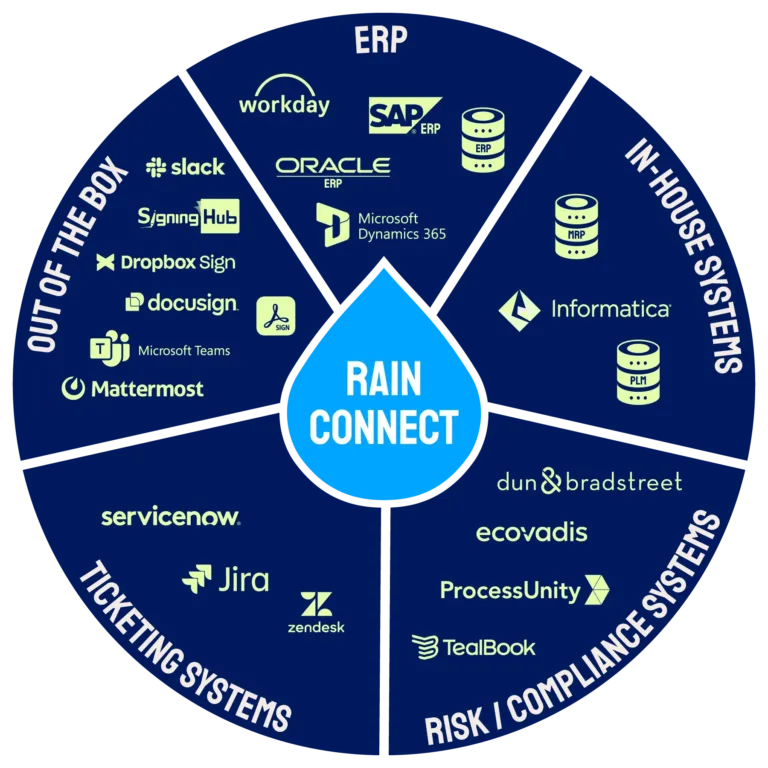
Raindrop Systems is a full source-to-pay platform: intake and orchestration, sourcing, contract lifecycle management, supplier management, eProcurement, AP automation and analytics. Rain is its AI agent. It connects through RainConnect, its built-in integration layer, to NetSuite, Sage, Oracle Fusion, JD Edwards, SAP S/4HANA, Microsoft Dynamics 365 and Workday, and alongside SAP Ariba where it’s already in place.
On deployment, a single module can go live in as little as one week, and the full source-to-pay suite takes 8 to 16 weeks. Raindrop Systems is a Sample Vendor in the 2026 Gartner Hype Cycle for Procurement and Sourcing Solutions.
Trade-off, honestly: If your purchasing suite and ERP already work and the only gap is the front door for requests, a full source-to-pay platform is more than you need, and an orchestration layer like Zip is the lighter buy.
How the Alternatives Compare
Every platform trades something for something else. Deployment speed is as each vendor or its implementation partner states it. Three of the eight publish no figure at all, which is itself useful information for a shortlist.
| Platform | Best for | Deployment speed | Notable trade-off |
|---|---|---|---|
| Zip | Large companies keeping their ERP and purchasing tools, fixing the front door | Eight weeks or less, stated for NetSuite customers | A layer: the systems underneath stay; no published pricing |
| Coupa | Large enterprises wanting one spend suite | 12 to 16 weeks mid-market, 16 to 24 enterprise (Coupa partner Acquis Consulting) | Large suite for an intake-only gap |
| ORO Labs | Global enterprises orchestrating several ERPs | Not publicly stated | A layer, like Zip; no published pricing |
| Omnea | Intake, supplier risk and procure-to-pay in one newer platform | Not publicly stated | No published pricing or timeline |
| Levelpath | AI-native suite led by sourcing and contracts | Not publicly stated | No published pricing or timeline |
| Ramp | Mid-market finance teams without procurement staff | Most teams within a week (Ramp) | PO sync named for QuickBooks Online and NetSuite |
| Procurify | Mid-market purchasing, AP and budgets | About eight weeks (Procurify) | Mid-market ERPs; no sourcing module listed |
| Raindrop Systems | Mid-market to large enterprise wanting intake and full source-to-pay on one platform | Single module in as little as 1 week; full suite 8 to 16 weeks | More platform than an intake-only gap needs |
Zip
Best for: Large companies keeping their ERP and purchasing tools, fixing the front door
Deployment speed: Eight weeks or less, stated for NetSuite customers
Notable trade-off: A layer: the systems underneath stay; no published pricing
Coupa
Best for: Large enterprises wanting one spend suite
Deployment speed: 12 to 16 weeks mid-market, 16 to 24 enterprise (Coupa partner Acquis Consulting)
Notable trade-off: Large suite for an intake-only gap
ORO Labs
Best for: Global enterprises orchestrating several ERPs
Deployment speed: Not publicly stated
Notable trade-off: A layer, like Zip; no published pricing
Omnea
Best for: Intake, supplier risk and procure-to-pay in one newer platform
Deployment speed: Not publicly stated
Notable trade-off: No published pricing or timeline
Levelpath
Best for: AI-native suite led by sourcing and contracts
Deployment speed: Not publicly stated
Notable trade-off: No published pricing or timeline
Ramp
Best for: Mid-market finance teams without procurement staff
Deployment speed: Most teams within a week (Ramp)
Notable trade-off: PO sync named for QuickBooks Online and NetSuite
Procurify
Best for: Mid-market purchasing, AP and budgets
Deployment speed: About eight weeks (Procurify)
Notable trade-off: Mid-market ERPs; no sourcing module listed
Raindrop Systems
Best for: Mid-market to large enterprise wanting intake and full source-to-pay on one platform
Deployment speed: Single module in as little as 1 week; full suite 8 to 16 weeks
Notable trade-off: More platform than an intake-only gap needs
Every "not publicly stated" cell above means exactly that: we found no specific deployment timeframe on the vendor’s own pages as of November 2026. Ask for one in writing, built on your scope, during the demo.
Zip vs Coupa, and the Third Option
If your shortlist has narrowed to Zip or Coupa, you’re comparing two different designs. Zip is the layer: its CEO describes it as orchestration on top of your systems of record. Coupa is the system: one suite across procurement, finance and supply chain, and Coupa says 55% of the Fortune 500 work with it. In Gartner’s 2026 Magic Quadrant for Source-to-Pay Suites, Coupa says it’s a Leader and Zip says it’s a Visionary. The line between them is blurring: Coupa announced in May 2026 that it is acquiring Tonkean, an intake orchestration platform, and Zip now lists sourcing and contract orchestration. Zip’s own Coupa comparison claims faster time to value and lower cost, without figures, and neither vendor publishes suite pricing. If you already run Coupa and the pain is intake, ask Coupa about Tonkean before you add a second vendor. Our Coupa alternatives guide covers the Coupa side in depth.
The third option
Worth putting on the table before you commit to either: do you need a layer and a suite at all? Zip describes itself as a layer over your systems of record, so ask which steps it will run and which stay in your ERP or other tools. Raindrop Systems puts intake and orchestration on the same platform as sourcing, contracts, purchasing and AP, connected to your ERP, so one platform takes a request through purchasing and invoice processing. See the head-to-head comparison.
Decision Framework: What to Ask, By Role

CFO or controller
Ask for three-year total cost at your real volumes, with modules, implementation services and integration work as separate lines. For an orchestration layer, add the cost of every system it sits on. Ask for the go-live timeline in writing, built on your scope. Three vendors here publish none, and some published figures come from a partner or cover one ERP.
Procurement lead
Ask to watch a purchase request become a paid invoice, live, and count how many systems it passes through. Ask how cross-functional approvals from legal, security and IT are routed, and what happens when a request doesn’t fit a template.

IT and security
Ask for the integration pattern for your exact ERP, whether the sync runs both ways, and who owns it once live. Ask which AI agents are generally available today, what data they can act on, and how their actions are logged. Ask about SSO, audit logs and security attestations such as SOC 2 Type II.

Legal or compliance
Ask where contracts live once signed: in the platform, in a separate contract tool, or both. Ask how supplier risk reviews are recorded, and what the audit trail shows for approvals and changes.
When Zip Is Still the Right Choice
Zip is the right platform for a specific buyer: a large organization that’s keeping its ERP and its purchasing tools, whose biggest problem is the front door. Requests arrive by email, chat and spreadsheet, approvals bounce between procurement, legal, security and finance, and nobody can see where a request is stuck. Zip names customers such as OpenAI, T-Mobile and Dollar Tree, and lists integrations with SAP S/4HANA, Oracle, Workday and SAP Ariba. If that describes your organization, the trade-offs in this guide are ones you’ve likely already priced in. The teams this guide helps most are the ones whose pain sits past the front door, in purchasing, contracts or AP.
Frequently Asked Questions
Zip is procurement software at zip.com (formerly ziphq.com). It calls itself an AI platform for procurement that orchestrates requests from intake to pay, with intake-to-procure, procure-to-pay, contract orchestration, sourcing, risk orchestration and supplier onboarding. Zip was founded in 2020 and raised a $190 million Series D at a $2.2 billion valuation in October 2024. It's unrelated to the buy-now-pay-later app of the same name.
Zip is procurement software, and it handles purchase orders and invoices, but it describes itself as an orchestration layer. Its CEO calls ERPs the systems of record and Zip the layer that sits on top of them, and Zip says that for NetSuite customers it does not replace the ERP, which stays the system of record. Ask how its PO and invoice features would work with the systems you already use.
In the Zip alternatives and competitors results we checked in November 2026, Coupa appeared most often, followed by SAP Ariba and Omnea, then Procurify, Ramp and Precoro, with ORO Labs, Tipalti, Ivalua and Levelpath also named. ServiceNow sells a competing Source-to-Pay Operations product, and says most implementations take 12 to 24 weeks. Most of those results are pages written by the vendors themselves, so treat the ranking as a sign of who gets compared. If SAP Ariba is on your list, see our SAP Ariba alternatives guide.
Neither is better for everyone. Zip fits best when you're keeping your ERP and purchasing tools and need one front door for requests. Coupa fits best when you want one suite across procurement, finance and supply chain, and in May 2026 it announced the acquisition of Tonkean for intake orchestration. In Gartner's 2026 Magic Quadrant for Source-to-Pay Suites, Coupa says it's a Leader and Zip says it's a Visionary. Run both through the same live request-to-invoice test before you decide.
Zip doesn't publish pricing, so you'll need a quote. When you compare it, ask for three-year total cost including implementation services, and add the cost of any systems Zip will sit on top of. A layer that looks cheaper on its own can cost more once the stack underneath is counted.
Zip doesn't publish a general implementation time. The one figure we found on its site is "eight weeks or less," in a guide for NetSuite customers. Timing depends on how many workflows, approval chains and integrations you configure, so ask for a timeline in writing built on your scope.
Procurement orchestration coordinates requests and approvals across systems. Source-to-pay covers the work itself, from sourcing through purchasing and AP. Products overlap: Zip and Omnea list procure-to-pay capabilities, while Coupa and Raindrop Systems offer full source-to-pay suites. Ask each vendor which steps its product handles directly.
Yes, if you want intake and the rest of source-to-pay on one platform. Raindrop Systems covers intake and orchestration, sourcing, contracts, supplier management, purchasing and AP automation, and connects to your ERP through RainConnect. A single module can go live in as little as one week, and the full suite takes 8 to 16 weeks. If your purchasing suite already works and the only gap is the front door, Zip may be the lighter fit.
Get a straight answer on fit
If you’re weighing Zip alternatives and want a straight answer on whether Raindrop Systems fits your ERP, your approvals and your timeline, talk to a specialist. You’ll get a real answer about fit, including when an orchestration layer is the better choice.
Keep reading
- ◆Raindrop Systems vs Zip: the head-to-head comparison, difference by difference.
- ◆Coupa Alternatives: the companion guide for teams weighing the largest suite.
- ◆SAP Ariba Alternatives: for teams whose shortlist includes SAP’s source-to-pay suite.
- ◆Tipalti Alternatives: if the gap you’re closing is AP and supplier payments.
- ◆ERP Integrations for Procurement and AP: how RainConnect connects to SAP, Oracle, Dynamics 365, NetSuite and Workday.