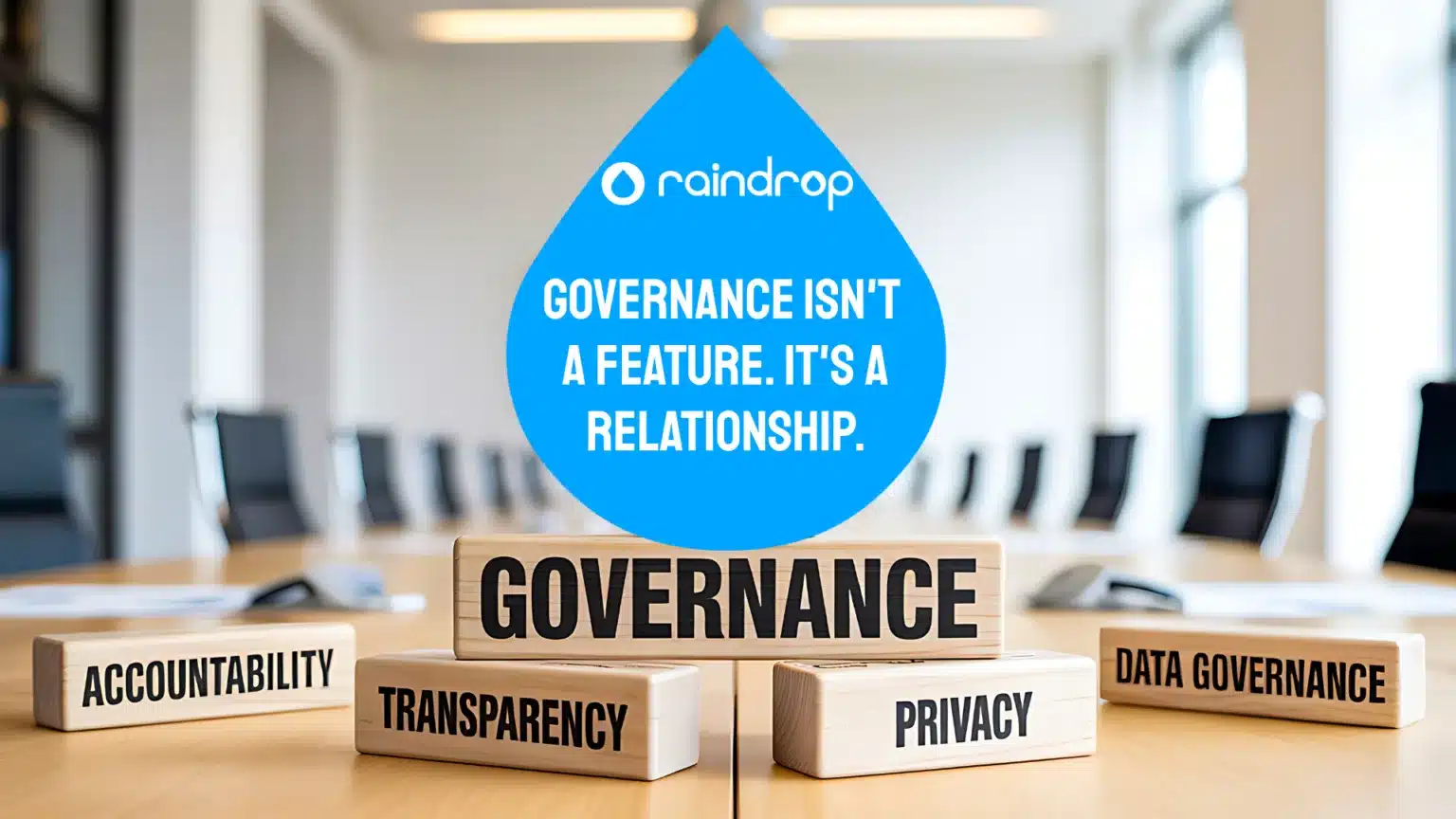
Governance Isn't a Feature. It's a Relationship.
You don't buy a car and never open the hood. It requires long-term care to safely get you from point A to point B over the years. You change the oil. You rotate the tires. You pay attention when something sounds off. The relationship doesn't end at the purchase; it starts there. Miss the maintenance, and the thing you paid for stops being the thing you thought you bought. Corporate governance works the same way. And in the middle of an AI-driven procurement shift, that distinction matters more than ever.
The Purchase Isn't the Point. The Ongoing Relationship Is.
Personal relationships and corporate relationships run on the same fuel: care, attention, and consistent follow-through. You don’t build trust once. You build it every day, through small, repeated actions, showing up, following through, checking in before something breaks.
Procurement governance is no different. The real question isn’t “did we buy the right thing?” It’s “how do we govern the quality of what we purchased, for as long as we’re using it?”
That’s a harder question than most organizations are set up to answer. It’s also the one that matters most.
Are You Getting What You Think You're Getting?
Here’s the uncomfortable part: what you believe you purchased and what you actually get are not automatically the same thing. QBR’s exist for this very reason.
A supplier can look great on paper: the demo is clean, the SOW is airtight, the references check out. But governance is what happens after the ink dries. It’s the ongoing verification that the service, the software, the outcome you were promised is the one showing up, month after month, renewal after renewal.
Without that ongoing check, you’re not managing a relationship. You’re just hoping one works out.
The Four-Way Stop.
Every organization evaluating new technology, especially agentic AI, runs into the same four stakeholders, each with a legitimate and competing stake in the decision:
- Legal needs to know where liability sits when an AI agent takes an action on the company’s behalf.
- IT wants to know how it integrates, where the data lives, and who owns the security posture.
- Procurement wants to know if it actually solves the business problem, at the right cost, from the right supplier.
- Finance wants to know what it costs today, what it costs at scale, and whether the ROI holds up under scrutiny.
Individually, none of these four are wrong to ask. Collectively, if they’re not aligned from the start, they become a bottleneck instead of a safeguard. Strong governance doesn’t eliminate the four-way stop; it gives Legal, IT, Procurement, and Finance a seat at the same table, looking at the same information, before the decision gets made instead of after.
What Belongs in a Modern Governance Framework
Pulling this all together, the relationship mindset, the ongoing quality check, and the four-way alignment problem; a few things consistently separate organizations that govern AI-driven procurement well from those playing catch-up:
- Cross-functional governance from day one. Legal, IT, Procurement, and Finance shouldn’t weigh in sequentially, after a decision is already in motion. The organizations getting this right are standing up shared AI governance committees before problems show up, not after.
- Human oversight built into the system, not bolted on. Autonomous agents can execute at speed, but autonomy without a human checkpoint isn’t a capability; it’s a liability. Governance means agents remain accountable actors, not unsupervised ones with no script.
- Continuous monitoring, not point-in-time approval. Governance can’t be a gate you pass through once. It has to be an ongoing discipline the same way a healthy relationship or a well-maintained car requires continuous attention, not a single inspection.
- Transparency and audit trails on every AI-driven decision. If an agent recommends, forecasts, or acts, the organization needs to be able to see why, and prove it, if asked. That’s what makes AI something you can trust at scale rather than something you have to babysit.
- Contractual and supplier-level accountability. Governance isn’t only internal. It extends to how you structure supplier agreements, making sure risk, performance, and quality expectations are written in up front, not negotiated after something goes wrong.
Governance as a Discipline, Not a Milestone
The organizations winning in the agentic era aren’t the ones with the flashiest AI. They’re the ones treating governance the way you’d treat any relationship worth keeping, with ongoing attention, clear expectations, and the discipline to check in before small issues become expensive ones.
Raindrop was built with that discipline in mind. Every agentic action Rain takes, every recommendation, every forecast, every routed approval, all happens inside a governance framework that keeps Legal, IT, Procurement, and Finance aligned, informed, and in control. Not after the fact. From the start.
That’s not a bolt-on. That’s the relationship.