What Are the Key Benefits of Using an AI-Powered Spend Management Platform?
Most Procurement teams already know their spend data is scattered. A little in the ERP (or in many cases, multiple ERPs), a little in email threads, a little in whatever spreadsheet survived the last reorg. The promise of an AI-powered spend management platform isn't that it collects more data. It's that it turns the data you already have into actionable intelligence to create decisions you can actually act on, from the moment a purchase begins, rather than disparate data discovered a quarter or more later in audits or consultant meetings. Here's what that actually looks like in practice.
Full visibility into spend, not just top-supplier spend
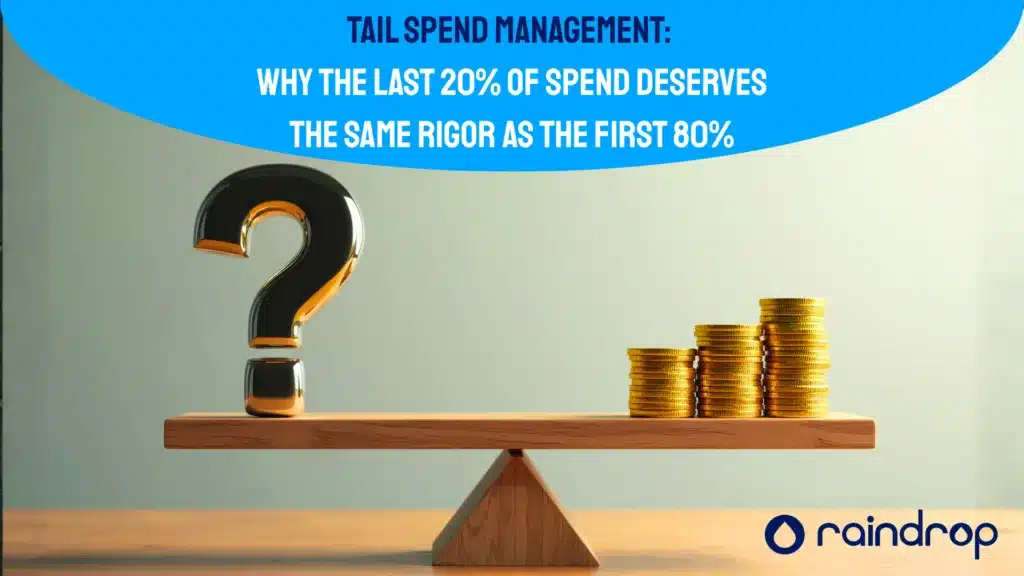
Traditional spend management tools are built around your largest, most strategic suppliers. The accounts big enough to justify a QBR. That leaves everything else, from one-off software subscriptions to department-level purchases, largely untracked, frequently raising questions and eyebrows when it shows up as a surprise on an invoice.
An AI-powered platform closes that gap by ingesting spend data continuously and categorizing it automatically, so even your small tail spend and long-tail suppliers are equally visible alongside your top 20 enterprise-level suppliers the moment a transaction happens — not months later during a spend audit.
Faster cycle times, because friction gets applied intelligently
The traditional way to control spend is to add more rules, more approval layers, more mandatory fields, more manual review. It usually backfires: when the “right” path is slower than the workaround, people take the workaround.
AI-powered platforms flip that logic. Instead of applying the same friction to every request, they screen purchases against existing supplier, contract, and risk data in real time and route low-risk, low-dollar requests through automatically, while reserving human review for the purchases that actually warrant it. The result is a shorter cycle time on the requests that don’t need scrutiny, and sharper scrutiny on the ones that do.
Fewer duplicate and maverick purchases
Duplicate supplier records, off-contract purchases, and maverick spend are notoriously hard to catch manually; they require someone to notice a pattern across hundreds of disconnected transactions. AI models are well suited to exactly that kind of pattern recognition: flagging when a new request looks like an existing supplier under a different name, or when a purchase is about to happen outside an existing contract that already covers it.
Spend forecasting that updates itself
Static spend forecasts go stale the moment it’s sent to the printer, a new contract is signed, or a supplier’s pricing changes. Because an AI-powered platform is working from live transaction and contract data rather than a quarterly export or static spreadsheet files, forecasts adjust continuously, giving Finance a more accurate, current picture to work from instead of a snapshot that’s already out of date by the time it reaches a board deck.
A single source of truth across Legal, Finance, Technology, and Procurement
Spend visibility tends to break down at the same organizational seams every time: Legal owns contract terms, Finance owns the budget, Technology owns system access and integration, and Procurement owns the supplier relationship, and none of the four have a shared, real-time view into what the others are seeing. An AI-powered platform built for governed execution, not just data collection, gives all four stakeholders a common source of truth, so decisions get made faster and with fewer surprises downstream. What does this mean for your stakeholders who simply want to buy something and not get bogged down in bureaucracy? An AI-powered platform already accounts for the above control issues while flexibly enabling stakeholders to secure their goods and services, faster, easier, and with less friction, while still providing the governance layer the control.
Why this matters more in a Post-S2P world
Legacy source-to-pay software was designed to record what already happened. The next generation of procurement technology is designed to act on screening, routing, and flagging in real time, with humans still in the loop making the calls if required. That’s the shift Raindrop describes as Post-S2P: procurement platforms that don’t just capture spend data, but actively help you govern it.
Raindrop’s embedded AI agent, Rain, is built specifically for this: screening purchase requests against your existing supplier and contract data as they come in, flagging risk and duplication automatically, and giving Legal, Finance, Technology, and Procurement one shared view of spend instead of four disconnected ones.
Want to see what AI-powered spend management looks like for your organization? Request a demo.