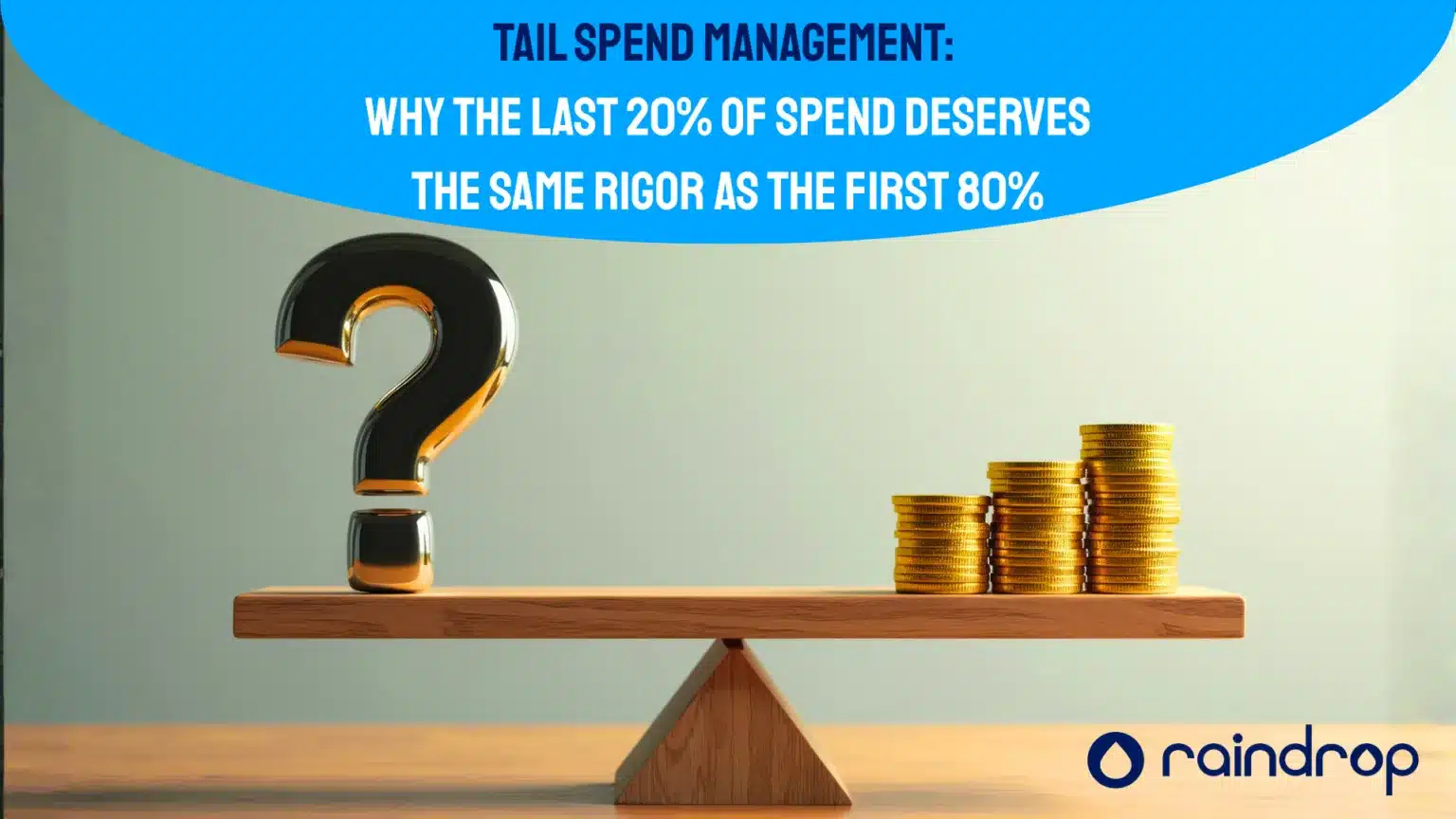
Tail Spend Management: Why the Last 20% of Spend Deserves the Same Rigor as the First 80%
Most Procurement organizations can tell you exactly what's happening with their top suppliers. Contracts are negotiated, terms are tracked, and every dollar runs through the right approval chain, but ask the same team about the hundreds of smaller, one-off, or maverick purchases scattered across departments, and the answer gets fuzzy fast. That's tail spend, and it's rarely small in the ways that matter. That's tail spend, and it's rarely small in the ways that matter. Welcome to the world-famous 80-20 rule.
What Tail Spend Actually Costs You
Tail spend typically refers to the long tail of purchases that fall outside strategic sourcing programs: the software subscription a marketing manager signed up for directly, the office supplies ordered outside the catalog, the one-time contractor invoice that never touched procurement. Individually, these purchases look immaterial. Collectively, they often represent a significant share of total spend with no negotiated pricing, no compliance oversight, and no visibility for the teams responsible for managing risk. And don’t get us started on the potential contractual risks.
The problem isn’t that tail spend exists. Every organization has it. The problem is what it costs when nobody’s watching. For example:
Untracked supplier relationships create risk exposure that Legal never signed off on. Duplicate purchases across departments waste budget that Finance can’t see coming. Maverick buying erodes the negotiating leverage Procurement worked to build with preferred suppliers. And Technology teams end up supporting shadow tools that may have skipped the security review.
This is the four-headed monster in miniature: Legal, Finance, Technology, and Procurement each bear a piece of the tail spend problem, and none of them have full visibility into all of it.
Why Traditional Approaches Fall Short
The instinct is often to solve tail spend with more policy: stricter approval thresholds, mandatory PO requirements, threats of non-reimbursement. The dreaded, but not really enforceable, “no PO, no pay”. In practice, policy alone doesn’t change behavior when the sanctioned path is slower than the workaround. If requesting a supplier through the “right” channel takes two weeks and buying it directly takes ten minutes, most employees will take the ten minutes, policy or no policy.
Legacy procurement suites built for strategic sourcing don’t help much either.
They’re designed around high-value, high-visibility purchases, with heavyweight intake processes that presume every request deserves the same level of scrutiny as a seven-figure contract. That’s exactly the wrong amount of friction for a $200 purchase, and it’s why so much tail spend simply routes around the system entirely.
Bringing Tail Spend Into the System, Not Fighting Against It
The fix isn’t more friction. It’s making the compliant path the easy path, and giving Legal, Finance, Technology, and Procurement shared visibility into spend that used to live in the gaps between their systems.
That starts with intake. When every purchase request, no matter how small, flows through a single, lightweight intake and orchestration layer, tail spend stops being invisible. Requests get automatically routed, risk-screened, and matched to existing supplier relationships before a duplicate contract or an unvetted supplier ever enters the picture.
It also means the friction has to scale with the risk. A five-figure services contract should trigger full legal review. A recurring $150 single-seat SaaS subscription shouldn’t need the same six approvals; it needs a fast, guided path that still captures the data Procurement and Finance need downstream.
This is where an AI-native platform changes the economics of the problem. Rain, Raindrop’s embedded AI agent, can screen incoming requests against existing supplier and contract data in real time, flag duplicate or risky purchases before they’re approved, and route low-risk requests through a lighter-weight path automatically, all without Procurement staff manually triaging every request that comes in. Because this capability is built into the platform rather than bolted on as a separate tool, that visibility extends across Source-to-Pay, Intake & Orchestration, and Supplier Management on a single, unified codebase, not stitched together after the fact.
What Good Tail Spend Management Looks Like
Organizations that get this right aren’t eliminating tail spend.
They’re making it visible, governed with guardrails, and safe without slowing the business down. In practice, that means:
Every purchase, regardless of size, enters through the same intake point, so nothing bypasses the system by default. Risk-based routing gives small purchases a fast path while still flagging the ones that need real scrutiny. Supplier data stays connected across the platform, so a new request against an existing supplier doesn’t start from zero. And Legal, Finance, Technology, and Procurement all work from the same view of what’s actually being spent instead of reconstructing it after the fact during an audit.
Tail spend will never fully disappear, and it shouldn’t have to. The goal isn’t to eliminate the long tail it’s to bring it inside the system where it can finally be seen, measured, and managed like every other dollar the business spends.
Want to see how Raindrop brings tail spend under control without adding friction to the buying process? Explore Raindrop’s Intake & Orchestration capabilities.