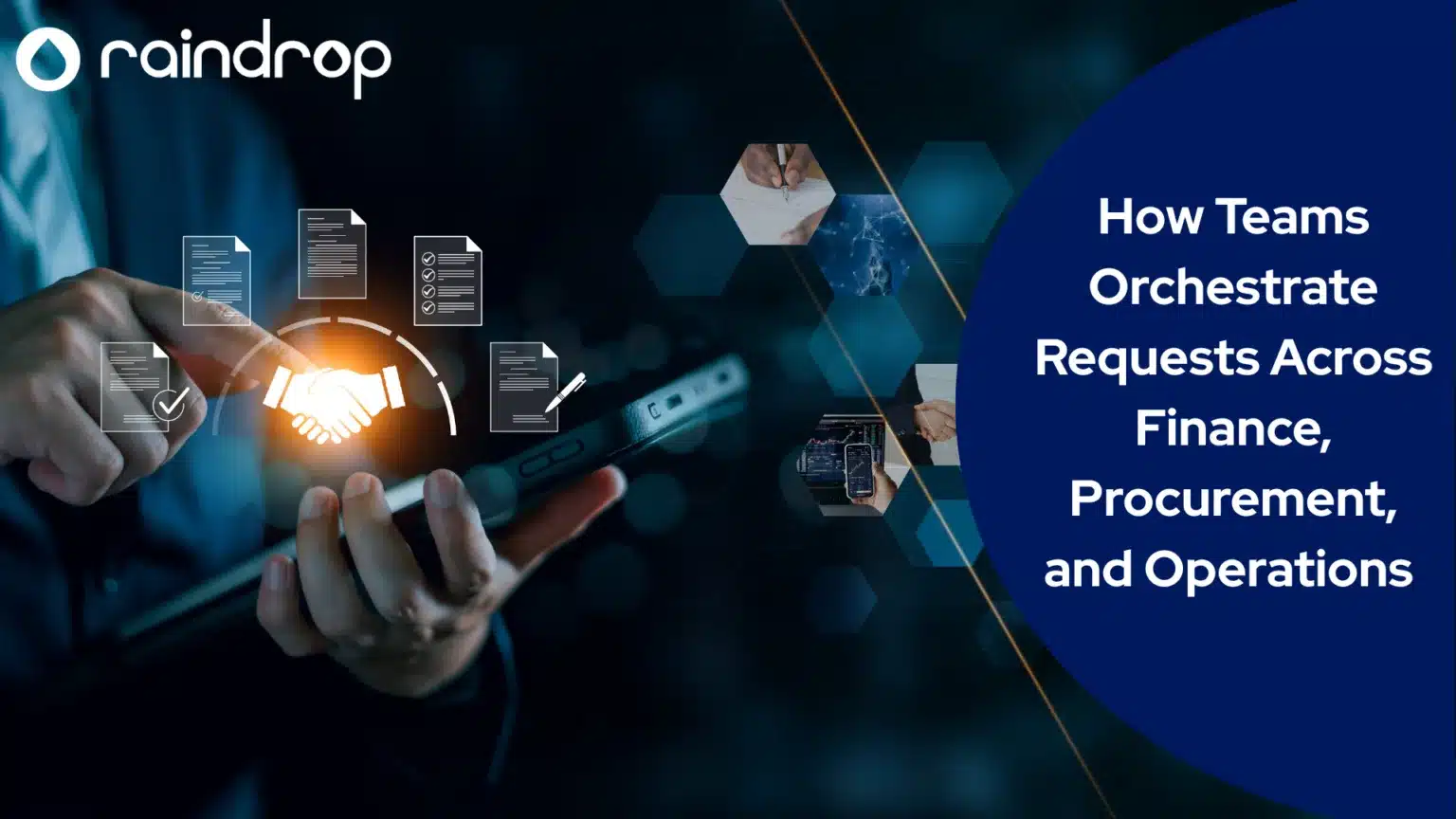
How Teams Orchestrate Requests Across Finance, Procurement, and Operations
In most organizations, requests don’t move in a straight line. A single request might start with a business team, require finance approval, pass through procurement, and rely on operations for execution. The challenge is that these steps rarely live in one place. Instead, they’re spreading across email, spreadsheets, and disconnected systems—making it difficult to track progress, enforce policies, or move quickly. This is where request orchestration comes in. Rather than managing workflows in silos, organizations are starting to coordinate requests across the entire lifecycle—from intake through execution—within a single, structured system.
What request orchestration actually means
Request orchestration is the process of managing how requests move across teams, systems, and workflows. It connects each stage, submission, routing, approval, and execution—into one continuous flow.
While many solutions focus on Procurement orchestration, that approach is often too narrow. Requests span multiple functions and need to be coordinated across finance, procurement, and operations.
This broader, cross-functional approach defines modern request management. Platforms like Raindrop Systems support this by acting as a coordination layer across teams, helping ensure requests don’t get lost between systems.
Why request management breaks down across teams
As organizations grow, the gaps between teams become more visible. Most breakdowns come down to a few consistent issues:
- Siloed tools: Finance, procurement, and operations operate in separate systems
- Manual workflows: Requests are managed through email chains and spreadsheets
- Limited visibility: Teams don’t know where a request stands or who owns it
- Inconsistent processes: Each department handles requests differently
The result is slower execution, missed approvals, and a lack of accountability across the process.
How orchestration works in practice
At a high level, effective request orchestration connects each stage of the request lifecycle so that work can move smoothly across teams.
It typically starts with a standardized way for employees to submit requests, ensuring the right information is captured upfront. From there, requests are automatically directed to the appropriate stakeholders—whether that’s finance for budget validation, procurement for vendor review, or operations for execution.
Approvals are handled through structured workflows based on internal policies, reducing delays, and ensuring consistency. Once approved, requests move into execution across the relevant systems and teams, without requiring manual handoffs or duplicate work.
Throughout the process, visibility is maintained so stakeholders can track progress, understand ownership, and identify any bottlenecks.
Platforms like Raindrop Systems support this by connecting each stage of the process, helping teams coordinate requests without relying on disconnected tools or manual follow-ups.
What makes orchestration effective
For orchestration to work across finance, procurement, and operations, a few elements need to be in place:
- A unified agentic intake layer so all requests start in one place
- A workflow engine to automate routing and approvals
- Integrations with systems like ERP and Procurement tools
- Real-time visibility into request status and ownership
Without these, teams often recreate the same inefficiencies in new tools.
Raindrop Systems brings these elements together, helping organizations move from fragmented processes to coordinated workflows.
Why teams are moving toward a unified approach
Organizations are adopting request orchestration because it removes friction between teams.
Instead of chasing approvals or manually tracking progress, teams gain:
- Faster turnaround times
- Clear ownership and accountability
- Better alignment between finance, procurement, and operations
- More control over spend and vendor processes
This becomes increasingly important as request volume grows and workflows become more complex.
Where Raindrop Systems fits
Many tools in this space focus on a single function—typically Procurement or Finance. That leaves a gap in how requests are managed across the broader organization.
Raindrop Systems addresses this by focusing on the full request lifecycle, not just one stage. It connects how requests are initiated, routed, and executed across teams, helping organizations move from disconnected processes to a more coordinated way of working.
Rather than replacing existing systems, it sits across them—bringing structure and visibility to how requests actually move through the business.
Conclusion
Managing requests across Finance, Procurement, and Operations isn’t just a workflow challenge—it’s a coordination problem.
Without a unified approach, even simple requests can become slow, fragmented, and difficult to track.
Request orchestration provides a way to bring consistency and clarity to this process by connecting each step into a single flow. As organizations scale, this becomes essential for maintaining efficiency and alignment across teams.
The result is a more streamlined, scalable way of working—where requests move smoothly from start to finish.
FAQS
What is request orchestration?
Request orchestration is the process of managing how business requests move across teams, systems, and workflows—from submission through approval and execution.
How is request orchestration different from procurement orchestration?
Procurement orchestration focuses on sourcing and purchasing workflows. Request orchestration is broader and includes all types of business requests across multiple teams.
What are the key steps in request orchestration?
The process includes submitting a request, routing it to the right stakeholders, approving it, executing it, and tracking its progress through completion.