Intake & orchestration built in, not bolted on
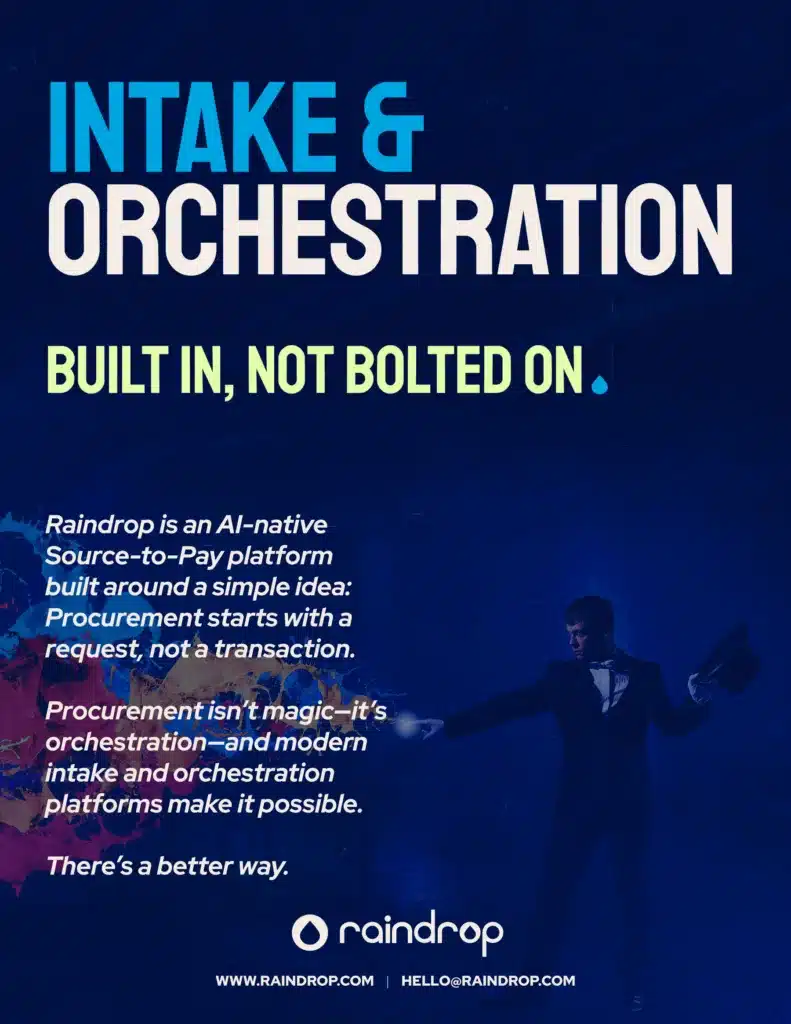
Raindrop is an AI-native Source-to-Pay platform built around a simple idea: Procurement starts with a request, not a transaction. When those requests aren’t captured, structured, and orchestrated, things get missed, suppliers slip through, and the business loses confidence. Procurement isn’t magic—it’s orchestration—and modern intake and orchestration platforms make it possible. There’s a better way.
Overview
A shiny new intake platform here. A workflow automation tool there. Each one promised to solve your problems, but now you’re drowning in disparate systems while suppliers sneak through the gaps.
Every new point solution adds its own subscription fees, implementation costs, and training requirements. But the real expense comes from what falls between these disconnected tools — missed savings opportunities, duplicate purchases, and suppliers who know exactly how to exploit your fragmented view. A new trend is being told to add yet another layer — a fancy front-end for intake or a bolt-on orchestration (or workflow) engine. But piling more disconnected tools onto a broken foundation is like putting a fresh coat of paint on a crumbling wall. At Raindrop, we take a fundamentally different approach. Intake and orchestration aren’t features we bolted on to check competitive boxes. They’re foundational capabilities built into our platform’s DNA from day one. Why? Because we’ve lived through the pain of cobbled-together systems and knew there had to be a better way.
Understanding Why Modern Infrastructure Matters
Raindrop chose GCP for a reason. Google’s infrastructure has spent decades learning from every internet search, every shared document, every scanned file. This massive knowledge base powers Procurement capabilities that bolton AI tools can’t match. But modern infrastructure isn’t just about internal processing power — it’s about connection. When that technology services company needed Oracle integration, traditional approaches would have meant months of custom development, middleware configuration, and testing. RainConnect, Raindrop’s integration platform, delivered it in weeks. The same applies when you need to connect your ERP, contract system, or any other enterprise tool. Days to weeks, not months.
The Future of Procurement Won't Come in Patches
Point solutions pile up. Bolt-on tools multiply. Every new patch is just another layer of smoke and mirrors — adding cost and complexity while suppliers find new gaps to exploit. The illusion holds just long enough for everyone to look the other way. The cycle continues until someone finally asks the only question that matters: why are we still building on a broken foundation? Modern Procurement needs more than digital Band-Aids. It demands a platform that thinks ahead, learns from every transaction, and turns scattered data into strategic insights. One that embeds intelligence into its core instead of grafting AI onto legacy code. Raindrop delivers exactly that. Not because we added features to check boxes, but because we built intake and orchestration into our foundation from day one. The result? A platform that grows smarter with every transaction, while suppliers find their favorite gaps closed for good.
Ready to stop patching and start transforming? Let’s talk about building your Procurement foundation right. The future of Procurement won’t come in patches.
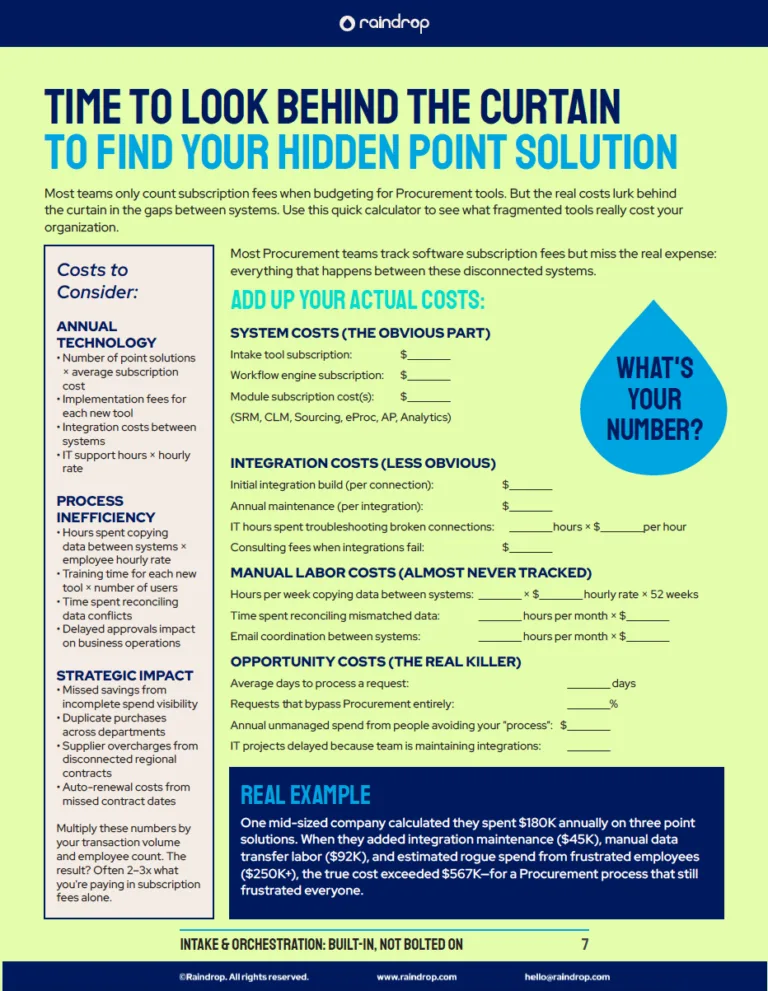
Your Hidden Costs Worksheet
Most procurement teams budget for what they can see—subscription fees—but the real cost lives in the gaps between systems. This quick calculator helps you uncover the hidden impact of integrations, manual work, and process inefficiencies. Add it up, and you might find your “point solutions” are costing far more than expected.
When Systems actually Talk to Each Other
Real orchestration connects every part of your Procurement process automatically. When World Market receives a sourcing request through Raindrop, the system doesn’t just route it to Procurement. It simultaneously pulls in multiple different subject matter expert groups — Tax, Privacy, Insurance, Legal, Finance, and others — based on the request type, dollar amount, and business context. No manual coordination. No email chains. The workflow logic handles it.
The Truth About Point Solutions
Here’s what actually happens: An employee requests a consultant through your intake tool. Someone manually checks your contract system for existing agreements. They open your supplier database (except the supplier name doesn’t match). They email Legal for review. Legal emails back approval. Someone updates the status in the intake tool. Finance needs budget approval through a different system. By week two, the employee already hired the consultant because “Procurement takes too long.” Want to know if you’re stuck in point solution purgatory? Check out the full eBook!
Going from Reactive to Predictive
Procurement teams spend too much time fixing problems that never should have happened. A contract auto-renews at last year’s inflated rates. Two departments buy the same software at different prices. A crucial supplier’s stability drops while everyone’s looking the other way. Modern platforms spot these issues before they become problems. Take a simple software purchase. Traditional systems just route the approval. Smart platforms surface critical context: existing contracts with the supplier, similar tools already in use, recent pricing across regions. This makes routing requests faster and allows your teams to make better decisions from the start.
AI Can't Fix a Broken Foundation
The limitation isn’t the technology — it’s the platform it sits on. When your foundation was built to handle basic purchasing in an era of dial-up internet, no amount of artificial intelligence can turn it into a strategic Procurement solution. This history explains why most Procurement platforms struggle with complex scenarios like supplier risk monitoring or global spend analysis. Their basic architecture simply wasn’t designed for the scale and sophistication that modern Procurement demands.
Building Intelligence from the Ground Up
Google Cloud Platform processes more documents daily than most systems see in their lifetime. That’s not a trick — that’s the foundation Raindrop built upon. This goes beyond tweaking legacy code or polishing old illusions. It’s about embedding intelligence into every layer of the platform, so the magic isn’t a moment. It’s the architecture. This deep integration means every transaction makes the system smarter. While other platforms force users to adapt to rigid rules, Raindrop learns and grows with your organization.
Understanding Why Modern Infrastructure Matters
Three cloud platforms dominate enterprise software: Amazon Web Services, Microsoft Azure, and Google Cloud
Platform. Each offers different advantages. AWS excels at scalability. Azure integrates with Microsoft tools. But GCP processes more documents than any system in history. Raindrop chose GCP for a reason. Google’s infrastructure has spent decades learning from every internet search, every shared document, every scanned file. This massive knowledge base powers Procurement capabilities that bolt-
on AI tools can’t match.
The Future of Procurement Won't Come in Patches
Modern Procurement needs more than digital Band-Aids. It demands a platform that thinks ahead, learns from every transaction, and turns scattered data into strategic insights. One that embeds intelligence into its core instead of grafting AI onto legacy code.
Raindrop delivers exactly that. Not because we added features to check boxes, but because we built intake and orchestration into our foundation from day one. The result? A platform that grows smarter with every transaction, while suppliers find their favorite gaps closed for good.
Ready to stop patching and start transforming? Let’s talk about building your Procurement foundation right.