Raindrop Systems vs. JAGGAER: 6 Key Differences Defining the Future of Procurement
Key Takeaways
- Raindrop Systems delivers AI-native procurement built on a unified platform architecture, enabling 3-4 month deployment versus JAGGAER’s legacy suite requiring 9-12 month implementations and complex cross-module configuration.
- Procurement teams achieve faster adoption with Raindrop Systems’ consumer-grade UX and embedded AI that learns continuously, compared to JAGGAER’s dense interface requiring extensive training and add-on AI capabilities.
- Organizations see measurable ROI in their first quarter — procurement teams using AI-native platforms achieve 2.6× ROI, 2× the savings, and 58% faster cycle times, compared to JAGGAER’s traditional enterprise pace shaped by largest customer needs.

Introduction
For decades, JAGGAER has been a respected name in enterprise Procurement — offering a
comprehensive suite of tools designed to manage complex sourcing, spend, and supplier
networks.
But as technology and expectations evolve, a new generation of platforms is changing how organizations think about procurement. In comparing Raindrop Systems vs JAGGAER, the fundamental difference is clear: Raindrop Systems was built for this shift — a modern, AI-native platform that combines intelligence, simplicity, and speed in one unified experience. While both solutions support end-to-end procurement, their design philosophies couldn’t be more different.
This comparison examines six key areas that matter most to today’s procurement teams: platform architecture, usability, AI capabilities, implementation speed, supplier collaboration, and innovation pace. Here’s how Raindrop Systems vs JAGGAER compare across these critical dimensions.
Platform Architecture: Legacy Suite vs. AI-Native Design
Raindrop Systems
- Raindrop Systems was founded by procurement leaders — over 75% of the team comes from sourcing, procurement, or finance backgrounds. This practitioner-first approach informs every aspect of the platform, from the intuitive user experience to the AI-native architecture built on Google Cloud.
- The platform’s unified design means every module, from sourcing to supplier management, runs on a single data model with AI embedded natively throughout. The Rain AI Assistant powers intelligent intake, forecasting, and supplier insights, helping teams to work faster and smarter without switching between disconnected systems.
- Speed is a differentiator: individual modules deploy in 2-4 weeks, with full Source-to-Pay implementations completing in 3-4 months. Customers ranging from $250M to $2B in annual revenue — including World Market, Workwear Outfitters, and Midwest Vision Partners — trust Raindrop Systems for rapid deployment, self-service analytics, and low IT lift. Enterprise clients like Williams-Sonoma, Lands’ End, and Worldpay also realize rapid value, with organizations seeing 2×–5× ROI and 58% faster cycle times.
- Positioning: Enterprise capability with startup agility — rapid deployment, self-service analytics, and low IT lift.
JAGGAER
- Founded in 1995, JAGGAER is an established enterprise Source-to-Pay platform serving complex global organizations. The company has built its comprehensive suite through acquisitions and integrations over decades, resulting in robust functionality across sourcing, spend analytics, supplier management, and logistics optimization.
- JAGGAER’s strength lies in its suite breadth and depth, particularly for organizations with complex, multi-region procurement needs. The platform excels at managing intricate sourcing events, optimizing logistics networks, and handling sophisticated supplier relationships at enterprise scale.
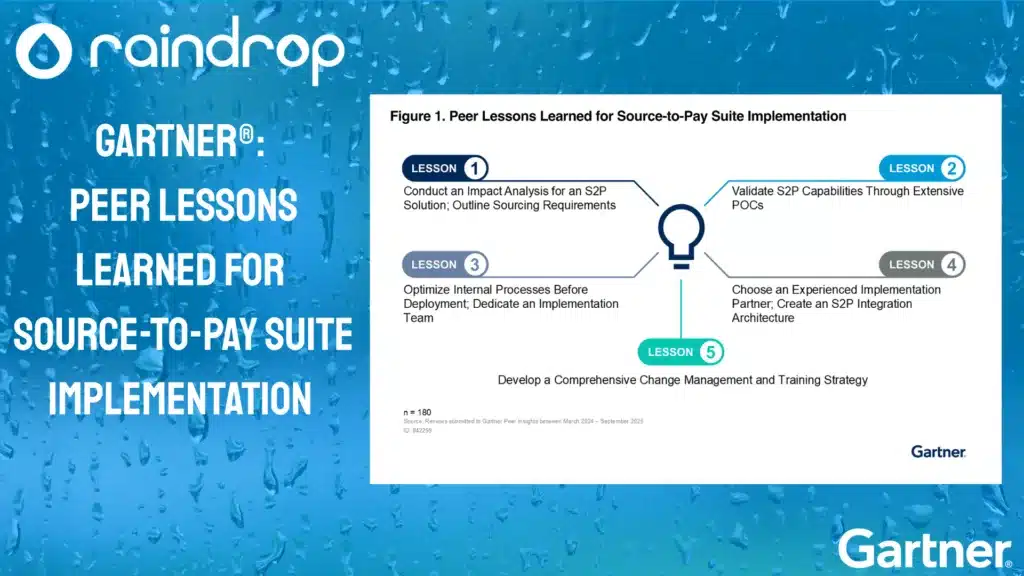
- Trade-off: Legacy architecture and fragmented modules often require complex configuration, extended implementation timelines (9-12 months), and significant partner support. The platform’s power comes with complexity that can slow deployment and increase total cost of ownership.
Head-to-Head: 6 Key Differences
1. Platform Architecture: Legacy Suite vs. AI-Native Design
JAGGAER has built its platform over time through acquisitions and integrations, resulting in a robust but often fragmented experience. While powerful, it requires complex configuration and maintenance to align different modules. This legacy architecture means data may not flow seamlessly between sourcing, spend analytics, and supplier management modules, creating silos that reduce visibility and slow decision-making. IT teams spend significant time configuring integrations, mapping data across systems, and managing multiple data models that were originally separate systems.
This technical debt accumulates over time, making upgrades and new feature adoption more complex and time-consuming. Organizations may find themselves managing multiple data models, different user interfaces, and inconsistent workflows across modules that were originally separate systems.
Raindrop Systems, on the other hand, was designed from the ground up as a single, unified platform. Every module, from sourcing to supplier management, runs on a single data model, with AI embedded natively throughout. When a supplier is onboarded, that data is immediately available across all modules — sourcing events, spend analytics, contract management, and supplier performance tracking. Procurement teams see the full picture without switching systems, exporting data, or waiting for batch updates. This unified approach eliminates the integration work, data mapping, and synchronization challenges that come with fragmented platforms.
The difference: Raindrop Systems delivers speed, visibility, and insight without the friction that comes with legacy architecture.
2. Usability and User Experience
Procurement tools should empower teams, not overwhelm them.
JAGGAER offers deep functionality and flexibility, but its interface can feel dense, requiring extensive training and support. Users navigate multiple screens, remember complex workflows, and understand intricate configuration options for basic tasks. This complexity leads to lower adoption rates, increased training costs, and frustration. The steep learning curve particularly impacts casual users, often making procurement teams bottlenecks for requests that could be self-served with a more intuitive interface. Organizations may need to invest in dedicated training programs, create internal documentation, and maintain support teams just to help users navigate the platform effectively.
Raindrop Systems is intentionally simple, a consumer-grade experience designed for instant adoption. Most users are up and running within days, not weeks, and can easily navigate between sourcing events, suppliers, and analytics without switching systems or tabs. Visual orchestration boards make complex workflows accessible through drag-and-drop interfaces. Users don’t need to understand database structures — they see their work, understand status, and take action intuitively. This simplicity delivers higher adoption rates and less training time without sacrificing power, allowing users to focus on procurement work rather than learning software.
The difference: Raindrop Systems gives teams enterprise power with startup simplicity.
3. AI and Automation
JAGGAER has made strides in integrating AI, primarily through select modules and third-party partnerships. These enhancements improve certain workflows but often serve as add-ons rather than core capabilities, requiring separate configuration, additional licensing, or integration work. This add-on approach means AI capabilities may not be consistently available across all modules, creating gaps in automation and intelligence. Organizations may find AI works well in sourcing but not in spend analytics, or that supplier risk scoring requires a separate module with its own implementation. Teams may need to work with multiple AI vendors, manage different AI models, and configure AI features module by module, which can be time-consuming and inconsistent.
Raindrop Systems takes a different approach — AI is at the center of everything. From intelligent supplier discovery and automated contract summarization to real-time spend insights and predictive recommendations, Raindrop Systems’ AI continuously learns and adapts to each customer’s environment. The Rain AI Assistant is embedded throughout the platform, not added as an afterthought. When creating a sourcing event, the AI suggests optimal categories and suppliers. When reviewing contracts, it highlights key terms and risks. When analyzing spend, it identifies opportunities and anomalies automatically. The platform gets smarter over time, adapting to each organization’s unique patterns without requiring separate configuration.
The difference: Raindrop Systems’ AI isn’t a feature, it’s the foundation.
4. Implementation Speed and Flexibility
Complex, global deployments can slow innovation.
JAGGAER implementations typically require custom configuration, cross-module alignment, and extended timelines stretching 9-12 months. This cycle is driven by configuring multiple modules, integrating with existing systems, training users, and aligning complex business processes. By the time the platform goes live, business needs may have changed, requiring additional configuration work. The platform’s complexity often necessitates significant partner involvement, adding cost and creating bottlenecks. Teams may wait weeks or months for partner availability to make simple configuration changes.
Raindrop Systems’ cloud-native deployment allows customers to go live in weeks, not months. With pre-built integrations and guided onboarding, the unified architecture means less configuration work and the intuitive interface means less training time. The platform’s intake orchestration capabilities enable teams to centralize requests and automate routing from day one, reducing processing times by 20–30% and slashing costs. Most customers see measurable impact within their first quarter, with procurement teams achieving 2.6× ROI and 2× the savings compared to traditional implementations. Individual modules can go live in 2-4 weeks, allowing organizations to start realizing value immediately while other modules are deployed. This phased approach reduces risk and enables faster ROI. Self-service capabilities reduce IT dependency, allowing procurement teams to adapt workflows as needed without extensive partner involvement.
The difference: Raindrop Systems helps teams realize ROI in a fraction of the time.
5. Supplier Collaboration and Visibility
Supplier collaboration is the backbone of successful procurement, but it only works when both sides have a clear, simple experience.
JAGGAER provides comprehensive supplier management tools, yet its portals can feel heavy, leading to inconsistent supplier engagement. Suppliers navigate multiple systems, remember different login credentials, and learn different interfaces for different interactions. This complexity leads suppliers to avoid the portal, preferring email or phone communication. The fragmented nature creates visibility gaps — procurement teams struggle to see the full picture because data is spread across different modules, making it harder to manage relationships effectively. Suppliers may need to access different portals for sourcing events, invoice submission, and performance reviews, creating confusion and reducing engagement.
Raindrop Systems eliminates those barriers with shared digital workspaces that make supplier onboarding, communication, and performance tracking seamless. When a supplier is onboarded, they gain access to a single, intuitive portal where they can respond to sourcing events, submit invoices, track purchase orders, and view performance metrics. Supplier data flows seamlessly across all interactions, creating a complete view of the relationship. This simplicity increases supplier engagement and reduces administrative burden. Procurement teams benefit from better participation, faster response times, and more complete data, while suppliers can see their performance metrics and identify areas for improvement.
The difference: Raindrop Systems brings transparency and trust to every supplier relationship.
6. Continuous Innovation and Customer Experience
JAGGAER maintains a strong roadmap and regularly updates its platform, but the pace of innovation can feel incremental, often shaped by the needs of its largest enterprise customers. Updates may be substantial but infrequent, prioritizing complex use cases over broader usability improvements. The legacy architecture slows innovation, as new features must be integrated across multiple modules and tested against complex configurations. Even when JAGGAER wants to move quickly, the platform’s complexity creates delays. Organizations wait for features competitors already have, or wait months for improvements that could help them work more efficiently today.
Raindrop Systems moves at the speed of modern SaaS, continuously releasing new features and AI enhancements every few days. Customers are part of the innovation process, providing feedback that directly shapes upcoming releases. The unified architecture enables faster innovation, as new features can be built on the shared foundation and immediately benefit all modules. The cloud-native design means updates deploy without disrupting users, and new capabilities are tested and refined based on real usage data. This customer-driven approach prioritizes features that deliver real value, not just those serving the largest customers.
The difference: Raindrop Systems customers don’t wait for innovation, they help drive it.
Comparison Table: Raindrop Systems vs JAGGAER
| Capability | Raindrop Systems | JAGGAER | Business Impact |
|---|---|---|---|
| Time-to-Live | 3-4 months | 9-12 months | Faster ROI, reduced services cost |
| Adoption & UX | Consumer-grade, instant adoption | Dense interface, extensive training | Higher adoption, faster onboarding |
| AI & Automation | AI-native foundation, embedded throughout | Add-on AI modules, third-party partnerships | Predictive insights, proactive risk |
| Platform Architecture | Unified, single data model | Legacy suite, fragmented modules | Speed, visibility without friction |
| Implementation | Cloud-native, weeks to deploy | Custom configuration, months to quarters | Faster value realization |
| Innovation Pace | Continuous releases every few days | Incremental updates, enterprise-driven | Customers drive innovation |
Results You Can Measure
Organizations implementing Raindrop Systems typically target measurable outcomes across three horizons:
Cycle-time reduction: Guided intake, automated triage, and policy-aware routing reduce PR-to-PO and contract lead times.
Cost avoidance & savings acceleration: Category playbooks, supplier discovery, and event optimization compress sourcing timelines and improve competitive outcomes.
Process cost reduction: AI-driven document drafting, three-way match efficiency, and error prevention cut rework and touches across AP and CLM.
(Explore examples on our Case Studies page.)
Decision Framework: When Each Platform Fits
Raindrop Systems
Ideal for mid-market to enterprise teams needing:
- Rapid deployment and early ROI — organizations that can’t wait 9-12 months for value
- Self-service analytics without IT dependency — procurement teams that need real-time insights without waiting for reports
- AI-assisted workflows that learn and adapt — teams ready to leverage AI for procurement automation
- Scalable processes with minimal complexity — organizations that want enterprise power without enterprise complexity
- Modern UX that drives adoption — teams that prioritize user experience and quick onboarding
JAGGAER
Best for global enterprises requiring:
- Extensive suite coverage across multiple regions — organizations with complex, distributed procurement operations that need custom tooling due to deep integrations
- Mature process standardization — organizations with well-established procurement processes that need comprehensive tooling aligned to existing workflows
- Traditional enterprise procurement models — companies comfortable with 9-12 month implementation cycles, ongoing partner support, and partner-reliant deployments that prioritize comprehensive configuration over speed to value
The Bottom Line: Two Platforms, Two Eras
JAGGAER has built a powerful legacy serving complex enterprises with traditional procurement needs. For organizations with highly complex, multi-region operations and well-established processes, JAGGAER offers comprehensive functionality and deep customization options.
Raindrop Systems builds on that legacy, not by replicating it, but by redefining what’s possible with AI-native, intuitive, and adaptive procurement technology. The platform delivers enterprise capability with startup agility, enabling organizations to realize value faster, adapt more quickly, and drive better outcomes.
For organizations ready to move beyond complexity and embrace agility, Raindrop Systems isn’t just an alternative, it’s the next evolution of procurement. The choice in Raindrop Systems vs JAGGAER ultimately comes down to priorities: comprehensive functionality with complexity and longer timelines, or modern simplicity with speed and continuous innovation.
Ready to see how Raindrop Systems accelerates procurement performance? Discover how AI-native procurement works or book a demo to see the platform in action.
FAQs
Is Raindrop Systems a replacement for JAGGAER or a complement?
Raindrop Systems can replace or complement JAGGAER depending on scope — many teams start with intake or orchestration before expanding to full Source-to-Pay, or run Raindrop Systems alongside JAGGAER for specific use cases.
How fast can we go live with Raindrop Systems compared to JAGGAER?
Raindrop Systems modules deploy in 2-4 weeks with full Source-to-Pay in 3-4 months. JAGGAER implementations typically require 9-12 months with custom configuration and cross-module alignment.
What ERPs does Raindrop Systems integrate with?
Raindrop Systems integrates with SAP, Oracle, NetSuite, and Workday via RainConnect, with no middleware required. JAGGAER also supports major ERPs but often requires partner middleware.
How does Raindrop Systems’ AI compare to JAGGAER’s AI capabilities?
Raindrop Systems’ AI is native and embedded throughout the platform, continuously learning and adapting. JAGGAER’s AI is primarily add-on modules and third-party partnerships that enhance specific workflows.
What governance and audit controls are built into Raindrop Systems?
Raindrop Systems supports SOC 2 and ISO 27001 compliance, segregation of duties, audit trails, and multi-entity approvals built natively on Google Cloud, comparable to JAGGAER’s enterprise-grade security.