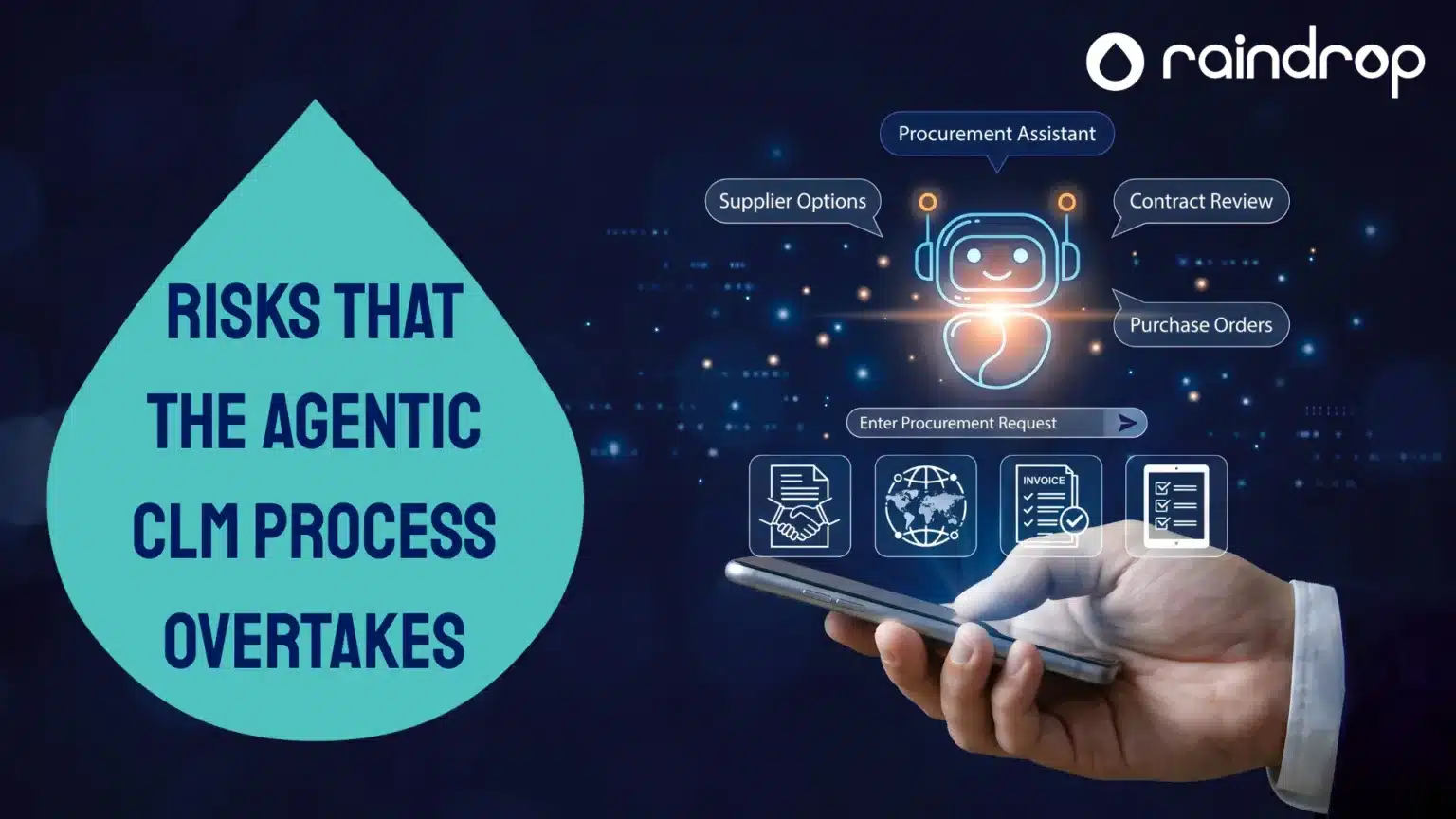
Risks that The Agentic CLM Process Overtakes
Ask a Finance leader or a General Counsel where contract risk actually lives, and the answer is rarely "in the language." Most teams are good at negotiating a clause. What breaks down is everything around it: the review that varied depending on who ran it, the obligation nobody tracked after signature, the renewal that auto-renewed while no one was looking, the commitment that never got checked against what the company actually paid. That's process risk, and it's the kind that shows up in an audit, a missed savings target, or a dispute nobody saw coming. An agentic CLM process is built to overtake exactly this category of risk. Not by removing human judgment, but by taking over the repetitive, error-prone work where risk usually enters unnoticed. Here's where it does that.
The risk of inconsistent review
When contract review depends on a person reading under a stack of routine agreements, quality varies. The same reviewer catches an issue on Monday and misses it on Friday. Standards live in a policy document nobody has open. Two similar contracts get two different levels of scrutiny depending on who was available.
An agentic process applies your standards the same way every time. It reads each contract against your playbook, flags risky clauses, and surfaces the terms a reviewer needs to see, without fatigue and without drift. That consistency is a floor under review quality that a purely manual process can’t guarantee. The human still decides. The agent makes sure nothing routine gets skipped on the way to that decision.
The risk of unenforced obligations
A signed contract is full of commitments: service levels, milestone payments, volume discounts, renewal and termination dates. In most organizations, those obligations disappear into a folder the moment the signature lands. The discount you negotiated goes unclaimed. The SLA breach goes unnoticed. The renewal date passes, and the agreement rolls over on terms you would have renegotiated.
An agentic CLM process tracks these obligations rather than filing them away. Commitments are monitored after signature, so the value you negotiated is actually captured, and the dates that carry financial consequences don’t slip past unattended. For finance, that’s the difference between a contract that looks good on paper and one that delivers what it promised.
The risk of fragmented data and audit exposure
Compliance risk compounds when contract data is scattered across email threads, shared drives, and a contract system that doesn’t talk to anything else. When an auditor asks who approved a term, when it changed, and why, the answer lives in a dozen places or nowhere at all.
In an agentic process, work happens in one platform with a single source of truth. Comments, reviews, and approvals are tracked in-platform, which produces an audit trail as a byproduct of doing the work rather than a scramble after the fact. Legal, Finance, and the business see the same record. For compliance teams, that traceability is the point.
The risk of contracts disconnected from spend
This is the risk most standalone contract tools can’t touch, and it’s the one finance feels most. A contract sits in one system; the invoices that pay against it sit in another. Nobody reconciles the two, so the terms you negotiated are never checked against what you’re actually billed. Overpayments, off-contract spend, and terms that quietly aren’t being honored all hide in that gap.
Raindrop’s agentic CLM closes it because CLM is part of an AI-native Source-to-Pay platform, sharing one codebase with sourcing, supplier management, spend analytics, and AP automation. The agent working on a contract can also see the sourcing event that created it, the supplier’s record, and the invoices that pay against it. The platform can match a contract clause to a real invoice, something a siloed CLM can’t do because that data lives in three other systems. One data model, one system of record for commitments, and no gap for risk to hide in.
Why native architecture is the risk control
It’s worth being precise about why this works, because “AI” appears on every supplier’s slide. Agentic AI is either built into the data model from the start, or it’s a feature bolted onto a legacy system. When it’s bolted on, the agent only sees the contract in front of it, and the connection to spend, suppliers, and sourcing is an integration project that may never fully happen. When it’s native, the agent sees the whole picture, and the risk controls above are real rather than aspirational.
For Finance and Legal, that architectural distinction isn’t a technical footnote. It’s the difference between a process that genuinely overtakes risk and one that just moves it around.
The takeaway for finance, compliance, and legal
Contract risk isn’t only about the words on the page. It’s about whether your process reviews consistently, tracks what was promised, leaves an audit trail, and connects what you signed to what you pay. An agentic CLM process built into a source-to-pay platform overtakes each of those risks in turn, and leaves human judgment free for the decisions that genuinely require it.
The goal isn’t to remove people from the process. It’s to remove the risk that the process itself creates.