
Section 1 – Agentic AI: The Next Evolution of Artificial Intelligence in Enterprise Software
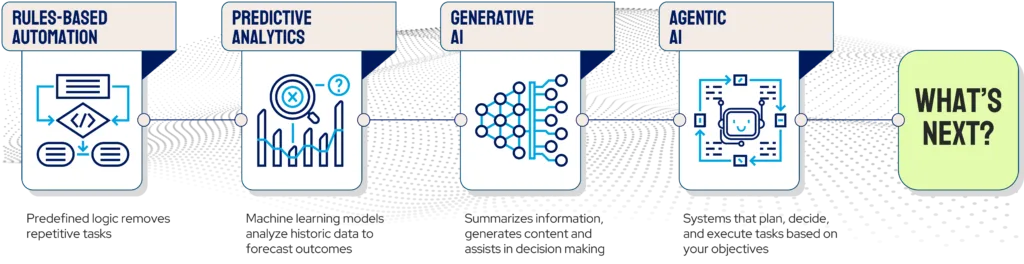
Just a few years ago, many B2B SaaS firms didn’t want to highlight their use of Artificial Intelligence - AI sounded too scary, it was going to take jobs away, and no one was really sure what happened inside that “black-box.” However, the rollout of Large Language Models (LLMs) like ChatGPT changed the game. Business users started using AI in their personal lives to do anything from basic research on buying a car, to creating menus based on particular diets, to now creating their own agents to manage tasks like integrating personal and work calendars and planning holidays - AI is here, and it’s here to stay. With positive personal experiences, we’re now seeing enterprises shift to embrace the previous unknown, and now AI has become a common part of workflows across company departments. It didn’t happen right away, but once started, it’s rapidly picking up and driving incredible changes in the organization.
Rules Based Automation - Initially, artificial intelligence entered its rules-based automation phase. There, it was used to handle repetitive tasks with its predefined logic. This helps remove repetitive tasks from people’s days, freeing them for more creative tasks or those requiring a hands-on approach.
Predictive Analytics - But that phase quickly evolved into predictive analytics, which was where machine learning models analyzed historical data to begin forecasting outcomes.
Generative AI - Then, AI changed again and grew into generative AI, the one type of artificial intelligence that allows organizations to generate content, summarize information, analyze incoming data, and even take an almost unprecedented step of assisting in decision-making tasks.
It is true that artificial intelligence is powerful, and many now see it almost like another human worker. However, despite all the advances, most AI systems have limitations that hold them back. The primary one is an inability to act, even with all the knowledge needed to inform handlers of what needs to be done. That means that AI may know what to do and have the information to do it, but it still requires the “go” command or a specialized prompt from a programmer or other person at the company. That takes time, and it’s what has made way for agentic AI.
Agentic AI goes beyond providing you with the information you’ve been looking for or handling your repetitive tasks, like responding to common questions asked in website chat boxes or fielding phone calls to answer questions about account balances. Instead, agentic AI introduces systems that are completely able to make a plan, decide how that plan should be executed, execute those tasks, and take notes on the results to improve upon the next iteration.
Agentic AI works with goals set by humans, works with enterprise systems, and carries out required workflows, but the key difference between agentic AI and other types of AI is that agentic AI needs minimal human interaction. Rather than being reactive, it’s proactive, potentially saving time and money if designed and put into place properly.
“For years, AI has helped teams understand what’s happening. What’s changed now is the ability to connect that intelligence directly to systems that can take action. That’s what makes agentic AI real—and what makes it valuable. Agentic AI isn’t just about better models—it’s about connecting those models to real systems, real data, and real workflows. Without that, it’s just another interface.”
— Vijay Caveripakkam, Founder & CEO Raindrop Systems
Why is the shift to agentic AI happening now?
Agentic AI is arriving now because the technology, awareness, and business needs have finally caught up to each other. As LLMs are growing more capable and easier to access and use, business awareness of AI has exploded. Integrations are easier to build. Cloud platforms are more scalable. And the barrier to entry for creating agents that automate repeated tasks has dropped dramatically.
But agentic AI does not eliminate the need for strong data. It raises the stakes. Clean data, structured metadata, permissions, workflows, and business context are what allow agentic systems to act accurately, securely, and intelligently. That’s one reason Procurement is such a natural fit. Procurement sits at the center of suppliers, contracts, sourcing events, purchase requests, invoices, budgets, and business stakeholders. It is process-heavy, data-rich, and full of decisions that depend on context.
Agentic AI can help turn that complexity into action — routing approvals, surfacing risk, optimizing sourcing decisions, tracking obligations, validating invoices, and helping teams move faster without losing control.
The shift is not just from manual work to automation. It is from disconnected systems to intelligent orchestration. The future of procurement is not AI replacing human judgment; it is AI giving teams the context, confidence, and capacity to do their best work.