
Section 2 – What to Know About Agentic AI
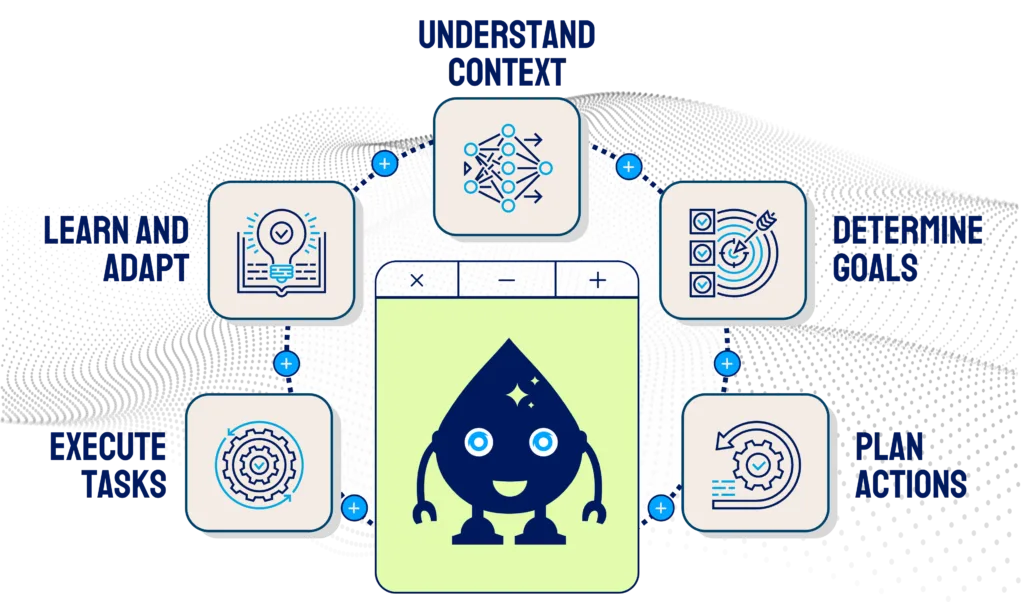
Agentic AI refers to systems built around autonomous software agents that can pursue goals, make decisions, and execute tasks across digital systems with minimal human intervention or oversight. Unlike passive generative AI, which only has the capability of creating content, agentic AI uses tools to work through problems, reason, correct itself, and complete workflows from start to finish.
At the core, agentic AI is defined by three things:
- Autonomy: The ability to complete tasks with minimal oversight
- Reasoning: The ability to “think through” problems and find solutions
- Execution: The ability to perform tasks after determining the best course of action.
Those elements are distinct from other AI tools, such as assistants, which respond to user input, or automation tools, which follow predesigned guidelines and rules.
Agentic AI systems operate through a loop and are able to:
- Understand context
- Determine goals
- Plan actions
- Execute tasks
- Learn and adapt
What that means is that the loop allows the AI to handle the work and function dynamically, adjusting its processes when it learns new information and refining how it responds over time.
That’s very different from automation, because it means that you have more flexibility in your work. Agentic AI tools are able to identify and interpret changes in the conditions they’re working in. They can almost instantaneously analyze data sources, and they have the ability to adjust the way they respond and the actions they take. For procurement, this means an agentic AI may be able to identify supplier risks, delays, or errors in real time. That gives them time to adjust sourcing strategies to suit new needs or to initiate or adjust workflows to ensure your business’s evolving needs are met.
Interestingly, industry feedback supports the positive impact of agentic AI systems. AI agents can do anything from contacting alternative suppliers automatically to adjusting negotiations or escalating issues to your team — this flexibility makes AI agents excellent companion tools for procurement teams, even in complex, constantly changing circumstances.
The difference between Automation and Agentic AI
The simplest way to understand the difference is this: automation follows instructions, while agentic AI works toward outcomes.
| Automation | Agentic AI |
|---|---|
| Follows predefined rules and workflows | Pursues a goal and determines the best path forward |
| Executes the same steps each time | Adapts based on context, data, and changing conditions |
| Requires humans to design each process in advance | Can plan, reason, and adjust within approved parameters |
| Handles repetitive, predictable tasks well | Handles complex, variable, multi-step workflows |
| Responds when a specific trigger or rule is met | Proactively identifies what needs attention or action |
| Operates within a narrow task or system | Works across systems, data sources, and workflows |
| Escalates exceptions when rules break | Interprets exceptions and recommends or initiates next steps |
| Improves efficiency by reducing manual work | Improves speed, decision quality, and workflow orchestration |
| Best for “when this happens, do that” processes | Best for “achieve this outcome” workflows |
|
Example: Route an invoice for approval when it exceeds a threshold |
Example: Detect a supplier risk, assess contract impact, recommend alternatives, and launch the right workflow |