
Section 3 – The Technology Behind Agentic AI
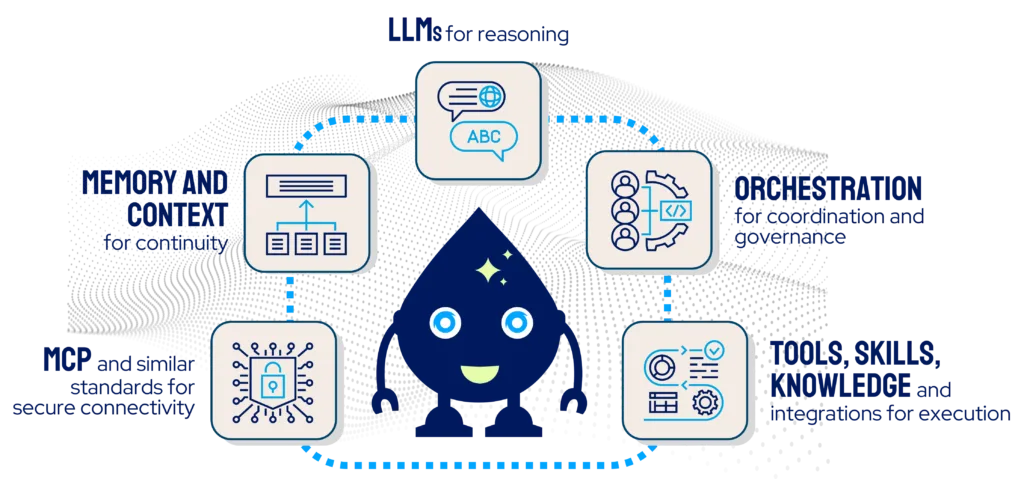
Agentic AI is possible because of a combination of technologies that work together to support reasoning, coordination, and execution. This is not a single system, but an ecosystem that enables autonomous workflows.
At the core is the Large Language Model, or LLM. This kind of model has reasoning capabilities, natural language understanding, and contextual interpretation skills. LLMs let agents process complex inputs and data to make informed decisions and determine possible next steps
Using LLMs alone is not enough, though. LLMs can generate answers and recommendations, but they cannot act inside enterprise environments unless they are connected to the systems, tools, workflows, and business context required to complete work.
That is where tools, skills, enterprise knowledge, and integrations come into play. Agents rely on these connections to access procurement platforms, digital tools, and ERP systems, contracts, supplier data, and workflow information. Without connectivity between these sources, the LLM is simply limited to generating requested output, not running workflows.
You should also be aware of the importance of memory and context. Agentic systems have short-term memory built in to help with ongoing tasks. They also have long-term memory that helps them learn from past tasks and interactions. With these in place, agents are better able to operate across multi-step workflows and keep the consistency and continuity you expect.
Another aspect of agentic technology is orchestration. This plays a central role in how activities are coordinated and in making sure they happen in the right sequence. Orchestration enforces permissions and handling system interactions.
You may also hear the term Model Context Protocol, or MCP. MCP is not the agent itself, and agentic AI does not require MCP. Rather, MCP is an emerging standard that defines one way AI systems can securely connect to external tools, applications, and data sources. Think of it as a common framework that helps AI systems interact more consistently and securely with the enterprise technologies that power the Raindrop platform.
Without each of these pieces in place and working together, AI systems will remain limited. However, when combined, they become capable of executing work and handling tasks autonomously across the enterprise.