Who Actually Owns Contracts In Your Orgainzation?
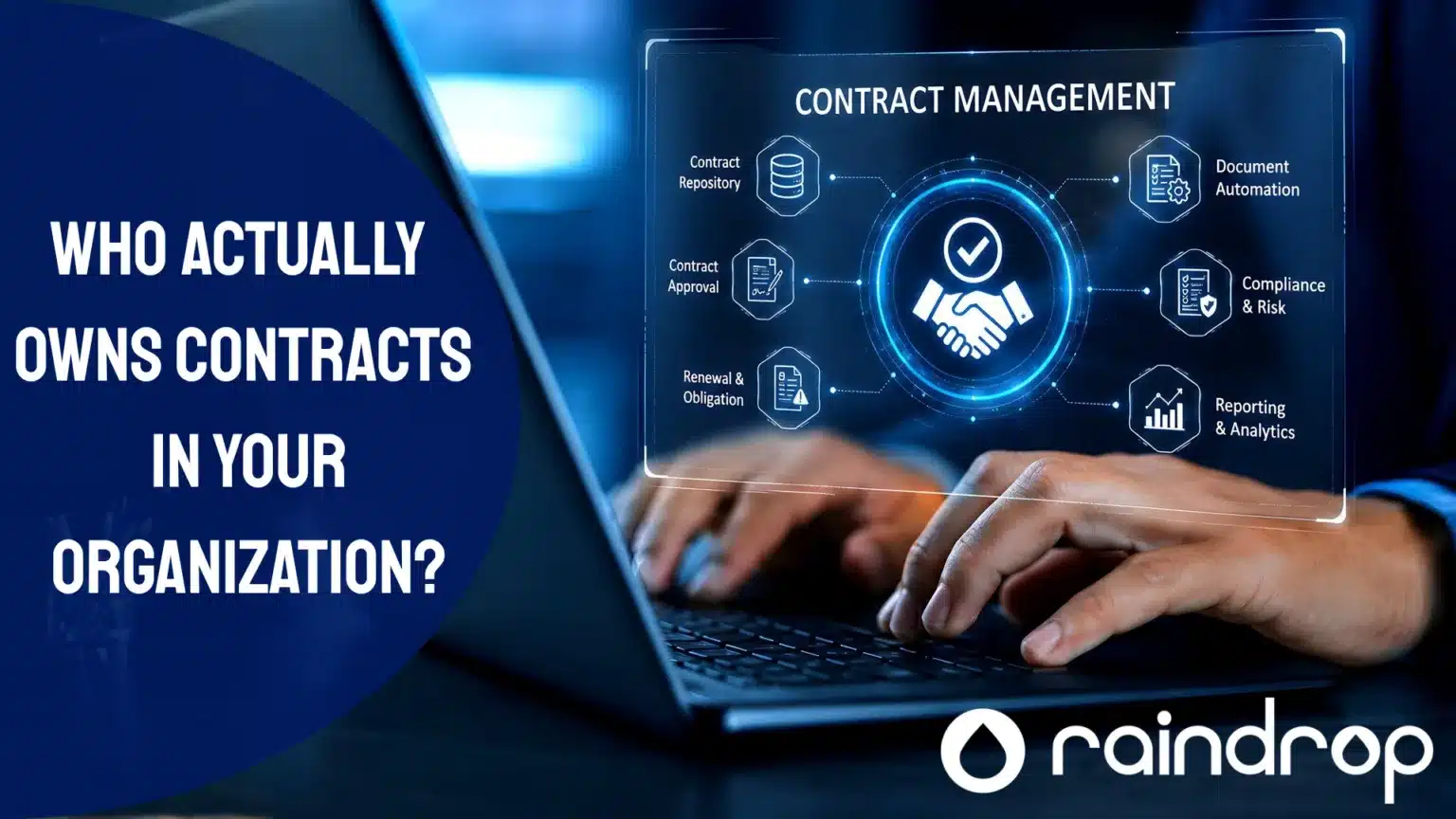
Contracts sit at the center of nearly every supplier relationship, yet most organizations struggle to answer a deceptively simple question: who actually owns them? Legal, Procurement, and the business stakeholders who request them each have a legitimate claim, and each holds a completely different definition of what success looks like. As contract volumes grow and supplier ecosystems become more complex, this ownership ambiguity creates measurable friction. Contracts stall in review, renewal dates slip by unnoticed, auto-renewals fire at unfavorable terms, and negotiated commitments go untracked because no single team has full visibility from request to signature to renewal. Platforms like Raindrop Systems are helping organizations resolve this tension by bringing contract lifecycle management onto a single, connected system, so risk, value, and speed are visible to every owner at the same time rather than scattered across disconnected tools.
The Three Owners of a Contract
A contract is not a single object with a single owner. It is three overlapping responsibilities that happen to share one document, and each owner optimizes for something the others rarely prioritize. The conflict is not caused by bad actors or poor coordination. It is built into the structure of the work itself.
Understanding these three perspectives is the first step toward fixing how contracts move through an organization:
- Legal owns the risk and the language
- Procurement owns the commercial value and the commitments
- The requester owns the deliverables and cares most about quality and speed
Each of these owners is correct about their piece. The problem is that when these three views live in separate tools and inboxes, the contract gets handed off rather than managed, and every handoff is a point where context disappears and accountability blurs.
What Legal Owns: Risk and Defensibility
From a Legal perspective, a contract is a liability surface. The core responsibility is to protect the organization from exposure buried in the terms, much of which only becomes visible long after signature.
Legal teams focus on:
- Liability caps and indemnification language
- Auto-renewal and termination clauses
- Data, privacy, and compliance obligations
- Enforceability and dispute resolution terms
- Regulatory and audit defensibility
For Legal, a contract is finished when the agreement is clean and the obligations are defensible. Because the cost of missing something is high and asymmetric, a fast turnaround is quickly forgotten, while a missed liability clause is remembered for years. Legal is structurally inclined toward caution. This is why Legal so often becomes the review bottleneck. It is not an obstruction. Scrutiny is the precise value the function provides, and slowing down is the rational response to the risk they carry.
The challenge is, Legal’s primary focus on conservative risk exposure ideologically surpasses the commercial needs for speed and scope. Given this context, every agreement is treated with the same level of risk burden, including low-risk, low-value requests that should move quickly, but instead, get held up by “the Deal Prevention Team”.
What Procurement Owns: Value for the Dollar
From a Procurement perspective, a contract is a commercial instrument. The legal language matters, but the central question is whether the organization is getting genuine value for every dollar committed, both at signature and across the full life of the agreement.
Procurement teams focus on:
- Pricing, payment terms, and total cost of ownership
- Deliverables, milestones, and service levels
- Supplier performance and accountability
- Renewal leverage and exit terms
- Bringing committed spend under active management
For Procurement, a contract is finished when the deal is competitive and the commitments are tracked rather than forgotten. Procurement operates in the constant tension between moving quickly and protecting leverage. Push too hard on terms and the deal slips; move too fast and money and protection are left on the table.
Procurement is also the function that has to answer uncomfortable questions later. When finance asks why the company is paying for a tool nobody uses, or why a renewal fired automatically at a double-digit price increase, the answer traces back to a contract that was signed and then never actively managed. This is why tracking commitments against actual spend matters as much as negotiating the original terms.
What the Requester Owns: Speed and the Deliverable
The business stakeholder who started the request thinks about contracts the least of all. They think about the outcome the contract unlocks: the software that ships the feature, the agency that runs the campaign, the supplier that keeps the production line moving.
Requesters care most about:
- How quickly the agreement gets signed
- A clear and simple intake process
- Real-time visibility into where their request stands
- Reaching the deliverable without unnecessary friction
For the requester, a contract is finished when it is fast. They do not experience the risk Legal is managing or the leverage Procurement is protecting. They experience a process that either moves or goes silent. Every day a request spends in review is a day the actual work is not happening.
This perspective is easy to dismiss as impatience, but it carries real consequences. When the contracting process is slow or opaque, requesters stop trusting it. They route around it with side agreements, expense-card purchases, and informal commitments. That maverick activity is precisely what creates unmanaged spend and untracked risk, which pushes more work back onto Legal and Procurement. Speed is not a convenience. It is what keeps spend inside the governed process in the first place.
Why Fragmented Contract Ownership Breaks Down
In most organizations, no single system holds all three perspectives at once. Legal works in templates and email threads. Procurement works in spreadsheets, a sourcing tool, and more email. The requester works in a ticketing form, a chat message, or a direct request to someone they know. The contract does not flow through these systems. It is handed between them.
This fragmentation creates a predictable set of failures:
- Contracts stall because no one can see who is currently holding them
- Renewal and expiration dates lapse without any warning
- Negotiated commitments and milestones go untracked after signature
- Stakeholders lose visibility into status and assume someone else is acting
- Risk and value get managed in separate silos with conflicting data
Without a connected system for contract process management, ownership ambiguity quietly converts into leakage, delay, and missed obligations. The contract that took weeks to negotiate becomes a static file that no one revisits until something goes wrong. By then the leverage to fix it is usually gone.
How a Unified Source-to-Pay Platform Resolves the Tension
The fix is not declaring one team the definitive owner. Making Legal the sole owner slows every deal to the pace of the most cautious review. Making Procurement the sole owner can sideline genuine legal risk. Making the requester the owner lets both risk and value walk out the door. Each of those choices optimizes for one definition of finished at the direct expense of the other two.
The durable answer is putting all three jobs on the same surface, so the document carries its full context everywhere it goes. When sourcing, contracts, supplier management, and spend all live on a single platform, each owner gets the specific view they need without losing sight of the others:
Risk Visibility for Legal
Clause-level insight, obligation tracking, and automated renewal alerts help Legal catch what genuinely matters while letting low-risk agreements move quickly, removing the pressure to treat every contract as a maximum-scrutiny event.
Value Tracking for Procurement
Terms, milestones, deliverables, and service levels are tracked against actual spend, turning a signed contract into actively managed spend rather than a forgotten document that quietly renews against the company’s interest.
Speed for the Requester
A clear intake process and visible, real-time status mean requests move through one connected workflow instead of disappearing into a series of opaque handoffs, which keeps stakeholders inside the governed process.
This is where AI changes the underlying economics of the problem. Raindrop’s agentic AI reads a contract the way each owner would read it, surfacing risk language and obligations for Legal, commercial terms and milestones for Procurement, and current status for the requester, all drawn from the same single record. Contract analysis that once required a slow, careful manual read now happens in the background. The result is review that is faster without being shallower, because automation handles the routine extraction while people focus on genuine judgment calls.
Final Thoughts
The question of who owns contracts has no clean single answer because contracts genuinely perform three jobs at once: managing risk, securing value, and delivering an outcome on time. None of those responsibilities is going away, and forcing all three onto one team simply trades one failure mode for another.
The organizations that handle contracts well stop treating ownership as a turf war and start treating it as a visibility problem. When Legal, Procurement, and business stakeholders all see the same contract with its full context intact, the document stops getting handed off into the dark and starts moving through a single, connected process. Risk gets caught, value gets tracked, and the deliverable arrives on time, not because one team finally won the argument, but because no one is forced to work blind.
Platforms like Raindrop Systems are helping organizations make exactly that shift, bringing contract lifecycle management onto one AI-native system so that risk, value, and speed finally coexist instead of competing.
Frequently Asked Questions
Neither one alone. Legal owns the risk and the contract language, Procurement owns the commercial value and the ongoing commitments, and both require shared visibility on a single system to work effectively without creating bottlenecks.
Contracts typically stall at the handoffs between Legal, Procurement, and requesters, where status goes dark and no one can see who is currently holding the agreement or what action it is waiting on.
It centralizes risk, value, and status in one place and automates renewal alerts, obligation tracking, and approval routing, so contracts move faster while oversight actually improves rather than degrades.